

“I and my Father are one.” – John 10:30
One doctrine all the cults and false religions (aside from Roman Catholicism) have in common is that they all deny or distort the doctrine of the Trinity. To the Jehovah’s Witness cult, the Trinity is anathema. Same with Islam. In fact, in Islam, to believe in the Trinity is considered an unforgivable sin (Surah 4:48; 5:72-73). But the Bible reveals one God in three Persons.
What is the Trinity?
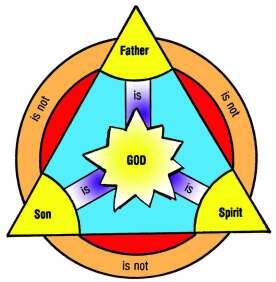
The Trinity (or the Godhead), which is idiosyncratic to the monotheistic Christian faith, is simply the one eternal God Yahweh/Jehovah who exists as three distinct, Divine, eternal, inseparable Persons: The Father, the Son, and the Holy Spirit. In other words, three eternal Divine Persons are identical to the one eternal Being of God (the word “Being” meaning what God is (eternal, omnipotent, etc). The Trinity of Persons shares the same undivided Divine substance, nature, or essence (Heb. 1:3; Isa. 61:1-3).
Jesus is not the Father nor the Holy Spirit. The Father is not the Holy Spirit nor Jesus. The Holy Spirit is not Jesus nor the Father. They all coexist simultaneously and are co-eternal, co-equal in nature, and co-powerful, yet are an inseparable unified one. They are not three roles played by one person (that is called modalism), nor are they three gods in a cluster (that is called tritheism). The one being of God (“He”) is also, and equally, “They,” and “They” are eternally together and cooperating. There exists both threeness and oneness of God. God’s oneness refers to the Divine nature and unity; His threeness to the plurality of Persons. However, the Persons of the Trinity are not merely sharing a Divine nature as three humans share a human nature; rather, their unity is so complete and perfect that they are one Divine Being while maintaining personal distinctions.

Consider these three propositions below:
(1) The Father, the Son, and the Holy Spirit are all DISTINCT PERSONS.
(2) The Father, the Son, and the Holy Spirit FULLY SHARE THE BEING OF GOD (not ⅓).
(3) There is only ONE GOD.
If these three propositions are true, it would follow logically and necessarily that the Trinity is true (i.e., there is one God, who exists in three distinct Persons).
The God of the Bible has one divine Mind/Intellect, divine Knowledge, and one divine Will. The Father, the Son, and the Holy Spirit inherently share the same divine Mind, divine Knowledge, and divine Will (Matt. 11:27; John 5:19; 10:15; 16:13–15, 30; 21:17; Col.2:3; 1 Cor. 2:10–11) because they share one essence, but the Persons express it distinctly within their eternal relations. If there were three separate divine wills, it would mean there are three separate divine beings, which is a form of tritheism or polytheism. The “Will” here is not like human individual wills (which could imply separation), but a unified divine volition expressed through each Person’s unique role. Because their will and action are always unified and inseparable, they cannot constitute three separate gods who could potentially conflict or act independently—such separation is metaphysically impossible given their shared divine essence.
Each says “I” (e.g., Matt. 3:17; John 8:58; Acts 13:2), speaks, loves, grieves, and relates — showing personal self-awareness. But what each “I” knows and wills is identical because they share the same divine Intellect and Will. And the “mind” refers to intellect/will, not subjectivity. The three centers of consciousness don’t equal three beings. That would be the case only if consciousness equals the essence. In the Trinity, consciousness is personal, essence is one.
The Father, Son, and Holy Spirit are God by identity with respect to the Divine Essence (what He is). Still, they are distinguished by predication with respect to their Personal Property (who They are in relation to the Others). Each distinct Person, or three centers of consciousness, has all the Divine attributes that are inherent in the Divine nature, but each also has a characteristic individuality, which is peculiar to the Person; the Father is unbegotten or uncaused source (John 5:26; 15:26; Eph. 4:4-6; 1 Cor 8:6), the Son is begotten (John 1:14, 18; 3:16; 16:28, 1 John 4:9) and assumed a human nature (John 1:14; John 1:51; Phil. 2:5-8), the Holy Spirit is proceeding (John 15:26).
They all have different levels of authority (John 5:19; 14:28; 15:26; 16:13-14; Matt. 28:18; 1 Cor. 11:3; Phil. 2:6-8) and some distinct functions or roles, but work together in perfect harmony and unity. For example, the Father sent the Son into the world (1 John 4:10). These roles are never reversed in the Bible. Likewise, the Holy Spirit is sent by Jesus to testify of Himself (John 14:26; 15:26), and Jesus perfectly submitted His will to the Father’s will (Luke 22:42; Heb. 10:7). When it comes to our salvation, it is based on the Father’s power and love (John 3:16; 10:29), the Son’s death and resurrection (1 John 2:2; Eph. 2:6), and the Spirit’s regeneration and seal (Eph. 4:30; Titus 3:5).
There is a mutual indwelling of the three of the Divine Trinity. The Persons permeate one another fully and eternally. In the Gospel of John, the Lord repeatedly told His disciples that He is in the Father and the Father in Him (John 10:38; 14:10-11, 20; 17:21, 23). Moreover, Jesus in His humanity is filled with the Holy Spirit from the Father (Luke 4:1,14; John 3:34; Isaiah 11:1-2; 61:1-2).
It’s worth noting that when Jesus (the Son) incarnated, He took on a complete human nature, which includes a distinct human will and human mind(though perfectly united and in submission to the single divine Will). This is why Jesus could pray, “Saying, Father, if thou be willing, remove this cup from me: nevertheless not my will, but thine, be done” (Luke 22:42). He was expressing His human will in submission to the single divine Will, which is the shared Will of the Father, Son, and Holy Spirit.
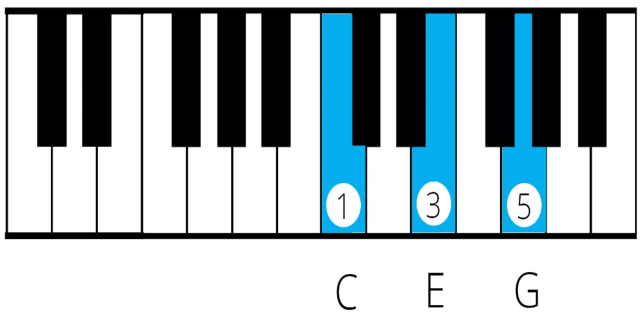
This is another illustration, albeit an imperfect one. Here is a music chord that contains three notes. The notes are distinct, but they all constitute the full chord. They each have the essence of music but are distinguished from one another as different notes. The C-note is not the E-note, and the E-note is not the G-note. Even without the other two notes, each note has the essence of music, and each musical note has the essence of music simultaneously, not sequentially. One can argue that the musical chord is the essence, not the musical sound. However, a musical chord cannot be reduced to only one note. The essence cannot be split into thirds. Moreover, in this illustration, a note is never played independently. The notes are always played together (the chord) and are inseparable. Likewise, the Father, the Son, and the Spirit are inseparable and always together. This illustration can show the beauty and harmony of the Trinity. However, the analogy does have flaws. For example, it suggests that the Divine essence is a compound structure made up of three components, which is contrary to the doctrine that God is non-composite and has no parts.



If we use the sortal “collection of droplets,” we count many.
We do not multiply clouds because the overlapping candidates share the same matter, occupy the same region, and function as a single meteorological reality. The difference lies not in the facts themselves, but in how numerical predicates are applied. This illustrates a broader principle sometimes described as numerical sameness without identity: distinct entities can be counted as one under one description and as many under another, without contradiction. Applying this logic to the doctrine of the Trinity can help clarify why the claim that God is both One and Three is not a mathematical error. Christian theology distinguishes between essence and person. There is one divine essence, the single, indivisible reality of what God is. There are three distinct persons, the Father, the Son, and the Holy Spirit, who are not identical to one another, yet are not three separate beings. In this framework, the Father, Son, and Holy Spirit are numerically the same God because they fully share the one divine essence, while remaining personally distinct. The numerical difference lies in who God is, not in what God is. Of course, the analogy must not be pressed too far. God is not composed of parts and does not change over time as a cloud does. The illustration does not explain the inner life of God, nor does it claim that divine persons are collections or components. Its purpose is more modest: to show that counting “one” or “many” depends on the category under which something is counted, and that numerical predication is not always univocal. Seen this way, the Trinity does not violate logic or arithmetic. Rather, it challenges an overly simplistic assumption about how numerical terms must apply to reality.
The importance of the Trinity
The doctrine of the Trinity explains how God can be eternal but not solitary or lonely, and how God is love without needing anything outside Himself (in His creation). There was always love between the persons of the Godhead (John 14:31; 17:24), and we know that God is love (1 John 4:8,16). But how can God be loving and personal without having relationships? Love requires a lover and a beloved; it requires a giver and a receiver. We can see in the Trinity that God is sort of analogous to a loving human family. From eternity past, the Father, the Son, and the Spirit have been in community and relationship, and expressing love is central to God’s character. This shows that God is eternally relational. Without multiple Persons in His eternal nature, God would need angels or humans to express love and be love. God was fully self-sustained in His triune nature. This aspect of God’s self-sufficiency is unresolved in Unitarian monotheism found in false religions or cults like Judaism, Islam, and the Jehovah’s Witnesses. It is difficult to maintain the independence and self-sufficiency of God on any other than the Trinitarian basis.
Moreover, the doctrine of the Trinity makes the incarnation of the Son of God and the atonement possible. Without being a multi-Personal God, the Father would not be able to lay the iniquity of us all on the Son and to crush Him (Isa. 53:5-6, 10), and the Son would not have been able to be the offering and sacrifice for sin to the Father (Eph. 5:2; 2 Cor. 5:21; 1 Jn. 4:10). According to the Bible, no man can redeem the life of another or give to God a ransom for Him — the ransom for a life is costly, no payment is ever enough — that a person should live on forever. Only God can redeem a soul from the power of hell (Ps. 49:7-15). Since Jesus is also God, He allowed Himself to be sacrificed for the sins of humanity (1 Tim. 2:5-6), reconciling us to Father (Rom. 5:10; 2 Cor. 5:19). Within the Trinity, Jesus voluntarily gave up His life for our sins (Jn. 10:11,17-18), and we see submission and humility as being central to the very character of God.
The triune nature of God is indeed difficult to wrap our minds around. However, since God is infinite and transcendent, this shouldn’t be surprising. This indicates that we are encountering the true God, who is mysterious and complex, rather than a human projection or creation. About His own nature, God himself said, “To whom will ye liken me, and make me equal, and compare me, that we may be like?” (Isa. 46:5). This may be why nothing is perfectly analogous to God’s triune nature.
Understanding the Trinity is understanding God as He revealed Himself to be. This is vital because if we are to worship God “in spirit and truth” (John 4:24), as Jesus taught, we must know and worship God as He really is. Those who reject the Trinity deny the nature of God. Also, without a sound biblical formulation about God, heretical views arise.
But doesn’t the Bible read God is one?
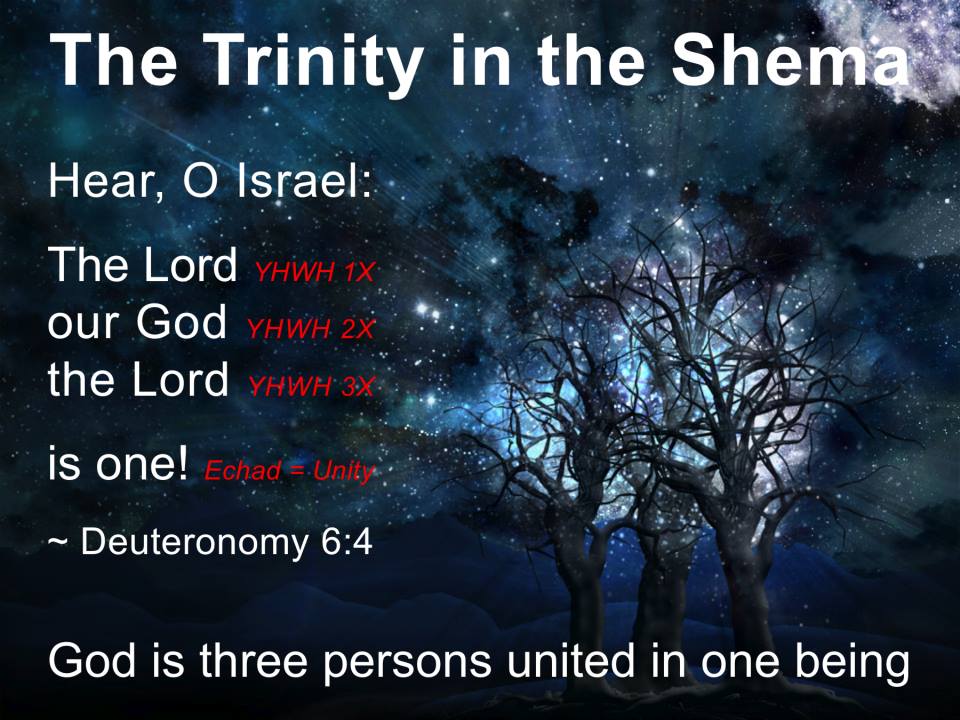
The Bible emphasizes God is indeed one: “4 Hear, O Israel: The Lord [Yahweh] our God [elohim] is one [echad] Lord [Yahweh]:” (Deuteronomy 6:4; Cf. Mark 12:29)
What’s interesting is that in the Deuteronomy 6:4 passage, the Hebrew word used for “one” is “echad,” which can be defined as and mean “united” or “unity,” as opposed to the word “yachid,” which is defined as a “solitary” one or one “alone.”
Strong’s Lexicon explains the usage of the word “echad” [bold mind]:
The Hebrew word “echad” primarily denotes the number one, indicating singularity or unity. It is used to express the concept of oneness, whether in numerical terms or in the sense of unity and harmony. In the context of time, it can mean “first” as in the first day of the month. It is also used to describe a collective unity, as seen in the Shema (Deuteronomy 6:4), where it emphasizes the oneness of God.
The word “yachid” is never used about God anywhere in the Old Testament. The Holy Spirit could have used “yachid” but instead used “echad.”
Strong’s Lexicon explains the usage of the word “yachid” [bold mine]:
The Hebrew word “yachid” primarily denotes the concept of being “only” or “unique.” It is often used to describe something singular or one-of-a-kind, emphasizing exclusivity or preciousness. In the context of family, it can refer to an “only child” or a “beloved child,” highlighting the special status or affection associated with being the sole offspring.
The word “echad” is used in Genesis 2:24:
“Therefore shall a man leave his father and his mother, and shall cleave unto his wife: and they shall be one [echad] flesh.”
Of course, it doesn’t mean a husband and wife become a singular one flesh, but instead become an unity or unified one flesh. Jesus quoted Deut. 6:4 in Mk. 12:29 and chose to use the Greek word that signifies singularity and unity, “heis,” which is the same word used by Jesus in Mt. 19:5, “For this cause shall a man leave father and mother, and shall cleave to his wife: and they twain shall be one [heis] flesh?” Jesus, instead,could have used the Greek word “monos” to mean a solitary one when He quoted Deut. 6:4.
Strong Lexicon explains the usage of the word “heis” [bold mine]:
The Greek word “heis” is primarily used as the numeral “one.” It signifies singularity and unity, often emphasizing the concept of oneness in various contexts. In the New Testament, “heis” is used to denote a single entity, whether it be a person, object, or concept. It is frequently employed to stress the uniqueness or exclusivity of something, such as the oneness of God or the unity of believers in Christ.
Notice in Genesis 5:2 that God called Adam and Eve by one name, Adam’s name:
“Male and female created he them; and blessed them, and CALLED THEIR NAME ADAM, in the day when they were created.”
Adam and Eve remained two distinct persons after God joined them as one flesh. God UNITED them in spirit – thus in this case two persons united as ONE.
Another example of an unity or unified one [echad] is found in Ezekiel:
“16 Moreover, thou son of man, take thee one stick, and write upon it, For Judah, and for the children of Israel his companions: then take another stick, and write upon it, For Joseph, the stick of Ephraim, and for all the house of Israel his companions: 17 and join them one to another into one stick; and they shall becomeone[echad] in thine hand.” (Ezekiel 37:16-17)
There was more than one stick, but it became an unified one in his hand.
More examples:
“And the Lord said, Behold,the people is one [echad], and they have all one language; and this they begin to do: and now nothing will be restrained from them, which they have imagined to do.” (Genesis 11:6)
“And Moses came and told the people all the words of the LORD, and all the judgments: and all the people answered withone [echad] voice, and said, All the words which the LORD hath said will we do.” (Exodus 24:3)
“And I will give them one [echad] heart, and one way, that they may fear me for ever, for the good of them, and of their children after them:” (Jeremiah 32:39)
“And when the seventh month was come, and the children of Israel were in the cities, the people gathered themselves together as one [echad] man to Jerusalem.” (Ezra 3:1)
Zechariah prophesied that at the time of the Messiah, all will know that God is one:
“And the Lord shall be king over all the earth: in that day shall there be one [echad] Lord, and his name one [echad]” (Zechariah 14:9)
The Holy Spirit could have used the word “yachid,” but instead used the word “echad.”
In contrast, the Hebrew word “yachid” is defined as only or a solitary one. An example:
“And he said, Take now thy son, thine only [yachid] son Isaac, whom thou lovest, and get thee into the land of Moriah; and offer him there for a burnt offering upon one of the mountains which I will tell thee of.” (Genesis 22:2)
Note: Elohim is the plural form of the word “god”. The God (Yahweh) of the Bible is referred to in the plural Elohim thousands of times. The very first verse of the very first book of the Bible reads “In the beginning God [Elohim] created the heaven and the earth” (Genesis 1:1). The word God in Hebrew is plural, but the word “created” treats it as singular. So there is singularity and plurality in the Godhead.
Three Persons are identified as God in the scriptures.
The Father is identified as God:
“For when He received honor and glory fromGod the Father, a voice came to Him from the Majestic Glory: This is My beloved Son. I take delight in Him!” (2 Peter 1:17)
The Son is identified as God:
“But unto the Son he saith, Thy throne, O God, is for ever and ever: a sceptre of righteousness is the sceptre of thy kingdom.” (Hebrews 1:8; Cf. Psalms 45:6).
“For in him dwelleth all the fulness of the Godhead bodily.” (Colossians 2:9)
[More references at Is Jesus Really GOD?.]
The Holy Spirit is identified as God:
“The Spirit of the Lord spake by me, and his word was in my tongue.
The God of Israel said, the Rock of Israel spake to me, He that ruleth over men must be just, ruling in the fear of God.” (2 Samuel 23:2-3)
“3 But Peter said, Ananias, why hath Satan filled thine heart to lie to the Holy Ghost, and to keep back part of the price of the land? 4 Whiles it remained, was it not thine own? and after it was sold, was it not in thine own power? why hast thou conceived this thing in thine heart? thou hast not lied unto men, but unto God.” (Acts 5:3-4)
In Acts 7, it reads that it was the Holy Spirit whom they resisted. In Psalms 78, it reads He was Yahweh:
“51 Ye stiffnecked and uncircumcised in heart and ears, ye do always resist the Holy Ghost: as your fathers did, so do ye.”(Acts 7:51)
“17 But they continued to sin against him, rebelling in the wilderness against the Most High….. 21 When the Lord [Yahweh] heard them, he was furious; his fire broke out against Jacob, and his wrath rose against Israel,… How oft did they provoke him in the wilderness, and grieve him in the desert! Yea, they turned back and tempted God, and limited the Holy One of Israel. They remembered not his hand, nor the day when he delivered them from the enemy.” (Psalm 78:17;21, 40-42)
Acts 28 shows that it was the Holy Spirit who spoke in Isaiah 6, who is Yahweh:
“Well spake the Holy Ghost by Esaias the prophet unto our fathers,26 Saying, ‘Go unto this people, and say, Hearing ye shall hear, and shall not understand; and seeing ye shall see, and not perceive:’” (Acts 28:25-26; Cf. Isa. 6:8-10)
“And Jesus answered him, The first of all the commandments is, Hear, O Israel; The Lord our God is one Lord:” (Mark 12:29)
Therefore, we must conclude there is a Trinity of Persons that is the one God!
Is there any other God?
“To you it was shown, that you might know that the Lord [Yahweh] Himself is God; there is none other besides Him... Therefore know this day, and consider it in your heart, that the Lord [Yahweh] Himself is God in heaven above and on the earth beneath; there is no other.” (Deuteronomy 4:35, 39)
“See now that I, even I, am he, and there is no god with me: I kill, and I make alive; I wound, and I heal: neither is there any that can deliver out of my hand.” (Deuteronomy 32:39)
“Ye are my witnesses, saith the LORD [Yahweh], and my servant whom I have chosen: that ye may know and believe me, and understand that I am he: before me there was no God formed, neither shall there be after me. I, even I, am the LORD [Yahweh]; and beside me there is no savior.”(Isaiah 43:10,11)
“Thus saith the LORD [Yahweh] the King of Israel, and his redeemer the LORD [Yahweh] of hosts;I am the first, and I am the last; and beside me there is no God. Fear ye not, neither be afraid; have not I told thee from that time, and have declared it? ye are even my witnesses. Is there a God beside me? yea, there is no God; I know not any.” (Isaiah 44:6,8)
“For thus saith the Lord [Yahweh] that created the heavens; God himself that formed the earth and made it; he hath established it, he created it not in vain, he formed it to be inhabited: I am the Lord [Yahweh]; and there is none else.” (Isaiah 45:18)
“Tell ye, and bring them near; yea, let them take counsel together: who hath declared this from ancient time: who hath told it from that time?have not I the LORD [Yahweh]? and there is no God else beside me; a just God and a Savior; there is none beside me. Look unto me, and be ye saved, all the ends of the earth: for I am God, and there is none else.” (Isaiah 45:21-22)
“For I am God, and there is none else; I am God, and there is none like me.” (Isaiah 46:9)
“And ye shall know that I am in the midst of Israel, and that Iam the LORD [Yahweh] your God, and none else: and my people shall never be ashamed.” (Joel 2:27)
“Among the gods there is none like unto thee, O Lord; neither are there any works like unto thy works. All nations whom thou hast made shall come and worship before thee, O Lord; and shall glorify thy name. For thou art great, and doest wondrous things:thou art God alone.” (Psalm 86:8-10)
Here is a trilogue. All Persons of the Trinity are speaking:
Psalms 2:1-12 “Why do the heathen rage, and the people imagine a vain thing?2 The kings of the earth set themselves, and the rulers take counsel together, against the Lord [Yahweh], and against his anointed, saying,3 Let us break their bands asunder, and cast away their cords from us.4 He that sitteth in the heavens shall laugh: the Lord [Yahweh] shall have them in derision.5 Then shall he speak unto them in his wrath, and vex them in his sore displeasure.6 Yet have I set my king upon my holy hill of Zion.7 I will declare the decree: the Lord [Yahweh] hath said unto me, Thou art my Son; this day have I begotten thee.8 Ask of me, and I shall give thee the heathen for thine inheritance, and the uttermost parts of the earth for thy possession.9 Thou shalt break them with a rod of iron; thou shalt dash them in pieces like a potter’s vessel.10 Be wise now therefore, O ye kings: be instructed, ye judges of the earth.11 Serve the Lord [Yahweh] with fear, and rejoice with trembling.12 Kiss the Son, lest he be angry, and ye perish from the way, when his wrath is kindled but a little. Blessed are all they that put their trust in him.”
Scriptures clearly show there is a plurality of Persons identified as the one God Yahweh. Here, Yahweh is speaking, but another Person is identified as Yahweh, and His Spirit sends Him:
Isaiah 48:11-17 “11 For mine own sake, even for mine own sake, will I do it: for how should my name be polluted? and I will not give my glory unto another.12 Hearken unto me, O Jacob and Israel, my called; I am he; I am the first, I also am the last.13 Mine hand also hath laid the foundation of the earth, and my right hand hath spanned the heavens: when I call unto them, they stand up together.14 All ye, assemble yourselves, and hear; which among them hath declared these things? The Lord [YAHWEH] hath loved him: hewill do his pleasure on Babylon, and his arm shall be on the Chaldeans.15 I, even I, have spoken; yea, I have called him: I have brought him, and he shall make his way prosperous.16 Come ye near unto me, hear ye this; I have not spoken in secret from the beginning; from the time that it was, there am I: and now the Lord God, and his Spirit, hath sent me.17 Thus saith the Lord [YAHWEH], thy Redeemer, the Holy One of Israel; I am the Lord thy God which teacheth thee to profit, which leadeth thee by the way that thou shouldest go.”
Yahweh sends another Person identified as Yahweh:
Zechariah 2:7-11”7 Deliver thyself, O Zion, that dwellest with the daughter of Babylon.8Forthus saith the Lord [YAHWEH] of hosts; After the glory hath he sent me unto the nations which spoiled you: for he that toucheth you toucheth the apple of his eye.9 For, behold, I will shake mine hand upon them, and they shall be a spoil to their servants: and ye shall know that the Lord [YAHWEH] of hosts hath sent me.10 Sing and rejoice, O daughter of Zion: for, lo, I come, and I will dwell in the midst of thee, saith the Lord [YAHWEH].11And many nations shall be joined to the Lord in that day, and shall be my people: and I will dwell in the midst of thee, and thou shalt know that the Lord [YAHWEH] of hosts hath sent me unto thee.”
It seems all three Persons of the Trinity are in the following passage (note that Jesus is called the Word of God in Rev. 19:13):
Zechariah 7:8-13 “8 And the word of the Lord came unto Zechariah, saying,9 Thus speaketh the Lord of hosts, saying, Execute true judgment, and shew mercy and compassions every man to his brother:
10 And oppress not the widow, nor the fatherless, the stranger, nor the poor; and let none of you imagine evil against his brother in your heart.
11 But they refused to hearken, and pulled away the shoulder, and stopped their ears, that they should not hear.12 Yea, they made their hearts as an adamant stone, lest they should hear the law, and the words which the Lord of hosts hath sent in his spirit by the former prophets: therefore came a great wrath from the Lord of hosts.13 Therefore it is come to pass, that as he cried, and they would not hear; so they cried, and I would not hear, saith the Lord of hosts:”
The Father speaks to the Son and calls Him God:
“8 But unto the Son he saith, Thy throne, O God, is for ever and ever: a sceptre of righteousness is the sceptre of thy kingdom. 9 Thou hast loved righteousness, and hated iniquity; therefore God, even thy God, hath anointed thee with the oil of gladness above thy fellows.”” (Hebrews 1:8-9; Cf. Psalm 45:6-7)
Proverbs reads that God has a Son who was involved with establishing all the ends of the Earth:
“4 Who hath ascended up into heaven, or descended? who hath gathered the wind in his fists? who hath bound the waters in a garment? who hath established all the ends of the earth? what is his name, and what is his son’s name, if thou canst tell?” (Proverbs 30:4; Cf. John 3:13)
God says He will save the house of Judah and save them by Yahweh their God:
“6 And she conceived again, and bare a daughter. And God said unto him, Call her name Lo-ruhamah: for I will no more have mercy upon the house of Israel; but I will utterly take them away. 7 But I will have mercy upon the house of Judah, and will save them bythe Lord [Yahweh] their God, and will not save them by bow, nor by sword, nor by battle, by horses, nor by horsemen.” (Hosea 1:6-7)
Yahweh says the Spirit of God is upon Him. Notice Yahweh is speaking in the first Person and then says the Spirit of the Lord God is upon Him.
“22 A little one shall become a thousand, and a small one a strong nation: I the Lord [Yahweh] willhasten it in his time. 61 The Spiritof the Lord God [Yahweh] is upon me; because theLord [Yahweh] hath anointed me to preach good tidings unto the meek; he hath sent me to bind up the brokenhearted, to proclaim liberty to the captives, and the opening of the prison to them that are bound; 2 to proclaim the acceptable year of the Lord, and the day of vengeance of our God; to comfort all that mourn;” (Isaiah 60:22-61:1-2)
Jesus read part of this scripture in the synagogue, and it was about Him:
“… And he began to say unto them, This day is this scripture fulfilled in your ears.” (Luke 4:16-21)
Yahweh talks about another Person identified as Yahweh in the third Person.
“And I will strengthen them in the Lord [Yahweh]; and they shall walk up and downin his name, saith the Lord [Yahweh].” (Zechariah 10:12)
The Holy Spirit is portrayed as a distinct Person:
“20 Thou gavest also thy good spirit to instruct them, and withheldest not thy manna from their mouth, and gavest them water for their thirst.” (Nehemiah 9:20)
“30 Yet many years didst thou forbear them, and testifiedst against them by thy spirit in thy prophets: yet would they not give ear: therefore gavest thou them into the hand of the people of the lands.” (Nehemiah 9:30)
“9 In all their affliction he was afflicted, and the angel of his presence saved them: in his love and in his pity he redeemed them; and he bare them, and carried them all the days of old. 10 But they rebelled, and vexed his holy Spirit: therefore he was turned to be their enemy, and he fought against them.” (Isaiah 63:10)
“Whither shall I go from thy spirit? or whither shall I flee from thy presence?” (Psalms 139:7)
Here we have two distinct Persons identified as Yahweh.
Isaiah 44:6 “Thus saith theLORD [Yahweh] the King of Israel, and his redeemer the LORD [Yahweh] of hosts; I am the first, and I am the last; and beside me there is no God.”
Two distinct Persons are identified as their Maker:
“5 For thy Maker is thine husband;the Lord [Yahweh] of hosts is his name;and thy Redeemer the Holy One of Israel; The God of the whole earth shall he be called.” (Isaiah 54:5)
God uses plural pronouns:
Genesis 1:26”26 And God said, Let usmake man in ourimage, after ourlikeness: and let them have dominion over the fish of the sea, and over the fowl of the air, and over the cattle, and over all the earth, and over every creeping thing that creepeth upon the earth.”
Genesis 3:22 “22 And the Lord God said, Behold, the man is become as one of us, to know good and evil: and now, lest he put forth his hand, and take also of the tree of life, and eat, and live for ever:”
Genesis 11:7 “7 Go to, let usgo down, and there confound their language, that they may not understand one another’s speech.”
All the Persons of the Trinity are referred to in the Psalms concerning creation:
Psalms 33:6 “By the word of the Lord were the heavens made; and all the host of them by the breath of his mouth.”
The Father is the Creator – Isaiah 64:8
“8 But now, O Lord [Yahweh], thou art our father; we are the clay, and thou our potter; and we all are the work of thy hand.” (Isaiah 64:8)
The Son is the Creator – Hebrews 1:8,10; Col. 1:15-17; John 1:3
“But unto the Son he saith….And, Thou, Lord, in the beginning hast laid the foundation of the earth; and the heavens are the works of thine hands:” (Hebrews 1:8,10)
“16 For by him were all things created, that are in heaven, and that are in earth, visible and invisible, whether they be thrones, or dominions, or principalities, or powers: all things were created by him, and for him:” 17 And he is before all things, and by him all things consist.” (Colossians 1:16-17)
“In the beginning was the Word, and the Word was with God, and the Word was God.2 The same was in the beginning with God.3 All things were made by him; and without him was not any thing made that was made….14 And the Word was made flesh, and dwelt among us, (and we beheld his glory, the glory as of the only begotten of the Father,) full of grace and truth.15 John bare witness of him, and cried, saying, This was he of whom I spake, He that cometh after me is preferred before me: for he was before me.16 And of his fulness have all we received, and grace for grace.”(John 1:1-3, 14-16)
It’s worth noting that the Targum Neofiti (which could have been written as early as the first century)—an Aramaic paraphrase of the Hebrew Bible—reflects an early Jewish tradition that associates creation with a divine intermediary. For instance, some manuscripts and scholarly reconstructions of the opening of Genesis read:
“From the beginning with wisdom the Son (1) of the Lord created the heavens and the earth. (Targum Neofiti, p. 497)
The footnote reads:
(1) The word Memera, logos, is probably missing in the text, as a hand has erased the waw of shakel, and therefore one should translate <<From the beginning (the Word) of the Lord with wisdom created and perfected the heavens and the earth>>. In Jewish-Christian dialogue Bereshit was often translated <<in the Son>>; cf. A. Diez Macho in Melanges E. Tisserant, I, Rome, 1964, 1974. (Ibid., p. 497)
Though the text involves technical manuscript variants, the presence of the ‘Memra’ (Word) as the agent of creation is a recurring feature of the Targums. This aligns remarkably well with the New Testament’s ‘Logos’ theology, suggesting that when John wrote that ‘all things were made through Him,’ he was using a theological category already familiar to his Jewish audience. In short, whether the text originally read ‘Son’ or ‘Word,’ the oldest Jewish paraphrases clearly identify a distinct divine entity through whom the world was made.
The following are more examples from the Targum (Genesis 1:2-3, 26-29) that the ‘Word’ (whom John identifies as Jesus) was involved with creation:
“And the earth was empty and without form, and desolate without a son of man or beast and void of all cultivation of plants and of trees, and darkness was spread over the face of the abyss, and a spirit of love from before the Lord was blowing over the face of the water. And the Word of the Lord said: Let there be light, and there was light according to the decree of his Word… And the Lord said: Let us create man in our image, similar to ourselves, and let him have dominion over the fishes of the sea and over the birds of the heavens, and over the cattle and over all the earth, and over every creeping thing that creeps upon the earth. And the Word of the Lord created the son of man in his (own) image, in a resemblance from before the Lord he created him, male and his partner he created them. And the Glory of the Lord blessed them and the Word of the Lord said to them: Be strong and multiply and fill the earth and subdue it and have dominion over the fishes of the sea and over the birds of the heavens and over every living thing that creeps upon the earth. And the Glory of the Lord said: Behold I have given you all the herbs that produce seed that are on the face of all the earth and every tree that has fruit on it – the fruit-bearing tree – to you I have given them as food.” (Ibid., pp. 497, 499)
And Genesis 2:1-3:
“And THEY completed the creatures of the heavens and the earth and all the hosts of them. And the Word of the Lord completed on the seventh day his work which he had created because there was rest and repose before him on the seventh day from all his work which he had created. And the Glory of the Lord blessed the seventh day and declared it holy because on it there was a great rest and repose before him from all his work which the Glory of the Lord created to do.” (Ibid., p. 500)
The Targums also show the “Word” or the “Memra” as a personal agent, again consistent with New Testament theology. We can look to the Targum Pseudo-Jonathan. The oral traditions and the theological content it contains could have predated 70 CE:
“And they heard the voice of the Word of the Lord God walking in the garden in the repose of the day…” (Genesis 3:8)
The following are from the Targum Onkelos, traditionally dated to approximately 80–130 CE. However, the oral traditions and the theological content are definitely before 70 CE:
“Moshe brought the people toward [the Divine Presence of] [the Word of] God, [leading them] out of the camp. They stood at the foot of the mountain.” (Exodus 19:17)
“[A word from before] God chanced to appear to Bil’am, and he said to Him: “I have set up the seven altars and I offered [as burnt-offerings] an ox and a ram on the altar.”” (Numbers 23:4)
“Yaakov made a vow, saying, If [the Word of] Elohim will be with me [my support], and guards me on this path that I am going, and gives me bread to eat and clothing to wear; And if I return in peace to my father’s house, and [the Word of] Adonoy will be my God;“ (Genesis 28:20–21)
The following are more examples:
“…And the Lord said by His Word, All the generations of the wicked which are to arise shall not be purged after the order of the judgments of the generation of the deluge, which shall be destroyed and exterminated from the midst of the world. Have I not imparted My Holy Spirit to them, (or, placed My Holy Spirit in them,) that they may work good works? And, behold, their works are wicked. Behold, I will give them a prolongment of a hundred and twenty years, that they may work repentance, and not perish.
[JERUSALEM. And the Word of the Lord said, The generations which are to arise shall not be judged after (the manner of) the generation of the deluge, (which is) to be destroyed, and exterminated, and finally blotted out. Have I not imparted My Spirit to the sons of men, because they are flesh, that they may work good works? But they do works of evil. Behold, I have given them a prolongment of a hundred and twenty years, that they may work repentance; but they have not done it.] (Targum Pseudo-Jonathan, in The Targums of Onkelos and Jonathan Ben UzzielOn the Pentateuch With The Fragments of the Jerusalem Targum From the Chaldee, by J. W. Etheridge, M.A., First Published 1862, 6)
These examples further demonstrate an ancient Jewish understanding of the Word as a distinct, divine personality.
The Holy Spirit is the Creator – Genesis 1:2, Job 33:4, 26:13; Psalms 104:30
“And the earth was without form, and void; and darkness was upon the face of the deep. And the Spirit of God moved upon the face of the waters.” (Genesis 1:2)
“By his spirit he hath garnished the heavens; his hand hath formed the crooked serpent.” (Job 26:13)
“The Spirit of God hath made me, and the breath of the Almighty hath given me life.” (Job 33:4)
“Thou sendest forth thy spirit, they are created: and thou renewest the face of the earth.” (Psalms 104:30)
Yet Yahweh ALONE is the Creator:
“6 Thou, even thou, art Lord [Yahweh] alone; thou hast made heaven, the heaven of heavens, with all their host, the earth, and all things that are therein, the seas, and all that is therein, and thou preservest them all; and the host of heaven worshippeth thee.” (Nehemiah 9:6)
“Thus saith the Lord [Yahweh], the Holy One of Israel, and his Maker, Ask me of things to come concerning my sons, and concerning the work of my hands command ye me.12 I have made the earth, and created man upon it: I, even my hands, have stretched out the heavens, and all their host have I commanded.”(Isaiah 45:11-12)
Ecclesiastes 12:1 and Isaiah 54:5 reference God as the Creators and Makers respectively, in the Hebrew.
Young’s Literal Translation is known to adhere strictly to the Hebrew. The following translation directly reflects the plural form of the Hebrew word used:
“Remember also thy Creators in days of thy youth, While that the evil days come not, Nor the years have arrived, that thou sayest, `I have no pleasure in them.’” (Ecclesiastes 12:1)
Jamieson-Fausset-Brown Bible Commentary reads:
Creator—“Remember” that thou art not thine own, but God’s property; for He has created thee (Ps 100:3). Therefore serve Him with thy “all” (Mr 12:30), and with thy best days, not with the dregs of them (Pr 8:17; 22:6; Jer 3:4; La 3:27). The Hebrew is “Creators,” plural, implying the plurality of persons, as in Ge 1:26; so Hebrew, “Makers” (Isa 54:5).
About Isaiah 54:5, Gill’s Exposition of the Entire Bible reads:
It is, in the Hebrew text (k) “thy Makers, thy Husbands”, Father, Son, and Spirit; though the relation of a husband is more peculiar to Christ….
What early church writers wrote concerning Genesis 1:26:
74 AD Epistle of Barnabas: “For the Scripture says concerning us, while He speaks to the Son, “Let Us make man after Our image, and after Our likeness” (Epistle of Barnabas, Chapter VI.—The Sufferings of Christ, and the New Covenant, Were Announced by the Prophets.)
150 AD Justin Martyr: Speaking of Jewish theologians Justin calls the Jewish teaching that God spoke to angels a hersey: “In saying, therefore, ‘as one of us, ‘[Moses] has declared that [there is a certain] number of persons associated with one another, and that they are at least two. For I would not say that the dogma of that heresy which is said to be among you (The Jews had their own heresies which supplied many things to the Christian heresies) is true, or that the teachers of it can prove that [God] spoke to angels, or that the human frame was the workmanship of angels. But this Offspring, which was truly brought forth from the Father, was with the Father before all the creatures.” (Dialogue of Justin Martyr, with Trypho, a Jew: Chapter LXII.—The Words “Let Us Make Man”)
180 AD Irenaeus: “It was not angels, therefore, who made us, nor who formed us, neither had angels power to make an image of God, nor any one else, except the Word of the Lord, nor any Power remotely distant from the Father of all things. For God did not stand in need of these [beings], in order to the accomplishing of what He had Himself determined with Himself beforehand should be done, as if He did not possess His own hands. For with Him were always present the Word and Wisdom, the Son and the Spirit, by whom and in whom, freely and spontaneously, He made all things, to whom also He speaks, saying, “Let Us make man after Our image and likeness; “ [Gen. 1:26]” (Against Heresies 4:20:1).
200 AD Tertullian: “If the number of the Trinity also offends you, as if it were not connected in the simple Unity, I ask you how it is possible for a Being who is merely and absolutely One and Singular, to speak in plural phrase, saying, “Let us make man in our own image, and after our own likeness;” whereas He ought to have said, “Let me make man in my own image, and after my own likeness,” as being a unique and singular Being? In the following passage, however, “Behold the man is become as one of us,” He is either deceiving or amusing us in speaking plurally, if He is One only and singular. Or was it to the angels that He spoke, as the Jews interpret the passage, because these also acknowledge not the Son? Or was it because He was at once the Father, the Son, and the Spirit, that He spoke to Himself in plural terms, making Himself plural on that very account? Nay, it was because He had already His Son close at His side, as a second Person, His own Word, and a third Person also, the Spirit in the Word, that He purposely adopted the plural phrase, “Let us make;” and, “in our image;”and, “become as one of us.” (Tertullian, Against Praxeas, Chapter XII. Other Quotations from Holy Scripture Adduced in Proof of the Plurality of Persons in the Godhead.)
200 AD Tertullian: Tertullian rejects the idea that God was speaking to Angels because our head is the creator, not a creature: “Since then he is the image of the Creator (for He, when looking on Christ His Word, who was to become man, said, “Let us make man in our own image, after our likeness”), how can I possibly have another head but Him whose image I am? For if I am the image of the Creator there is no room in me for another head” (Tertullian,Book V, Elucidations, Chapter VIII.—Man the Image of the Creator, and Christ the Head of the Man.)
200 AD Tertullian: “In the first place,because all things were made by the Word of God, and without Him was nothing made. Now the flesh, too, had its existence from the Word of God, because of the principle, that here should be nothing without that Word. “Let us make man,” said He, before He created him, and added, “with our hand,” for the sake of his pre-eminence, that so he might not be compared with the rest of creation.” (Tertullian:On the Resurrection of the Flesh, Elucidations, Chapter V.—Some Considerations in Reply Eulogistic of the Flesh. It Was Created by God.)
Origen: “it was to Him that God said regarding the creation of man, “Let Us make man in Our image, after Our likeness.”” (Origen Against Celsus, Book V, Chapter XXXVII)
Novatian: “For who does not acknowledge that the person of the Son is second after the Father, when he reads that it was said by the Father, consequently to the Son, “Let us make man in our image and our likeness; “ and that after this it was related, “And God made man, in the image of God made He him? “Or when he holds in his hands: “The Lord rained upon Sodom and Gomorrah fire and brimstone from the Lord from heaven?”” (A Treatise of Novatian Concerning the Trinity, Chapter XXVI. Argument.—Moreover, Against the Sabellians He Proves that the Father is One, the Son Another.)
In Genesis 19:24, there are two Persons identified as Yahweh who rained brimstone and fire: One who was on earth and the other from heaven:
“24 Then the Lord [Yahweh] rained upon Sodom and upon Gomorrah brimstone and fire fromthe Lord [Yahweh] out of heaven;”
The Targum read:
“And the Word of the Lord made to come down upon Sodom and Gomorrah sulphur and fire from before the Lord, from the heavens.” (Targum Neofiti, p. 544)
Amos 4:10-11 identifies two distinct persons as Yahweh, just as in Genesis 19:24, when discussing the same event.
“10 I have sent among you the pestilence after the manner of Egypt: your young men have I slain with the sword, and have taken away your horses; and I have made the stink of your camps to come up unto your nostrils: yet have ye not returned unto me, saith the Lord [Yahweh].11 I have overthrown some of you, as God overthrew Sodom and Gomorrah, and ye were as a firebrand plucked out of the burning: yet have ye not returned unto me, saith the Lord [Yahweh].” (Amos 4:10-11)
Jeremiah writes something similar. Yahweh speaks of God in the third Person:
“As God overthrew Sodom and Gomorrah and the neighbour cities thereof, saith the LORD [Yahweh]; so shall no man abide there, neither shall any son of man dwell therein.” (Jeremiah 50:40)
Yahweh again speaks of God in the third Person:
“17 Behold, I will stir up the Medes against them, which shall not regard silver; and as for gold, they shall not delight in it.18 Their bows also shall dash the young men to pieces; and they shall have no pity on the fruit of the womb; their eye shall not spare children. And Babylon, the glory of kingdoms, the beauty of the Chaldees’ excellency, shall be as when God overthrew Sodom and Gomorrah.” (Isaiah 13:17-19)
What early church writers said about Genesis 19:24:
150 AD Justin Martyr: In this text, Justin the Christian is trying to convince Trypho the Jew that Jesus is God, by showing one of the three men who appeared to Abraham, was Yahweh himself: “ I [Justin] inquired. And Trypho said, “Certainly; but you have not proved from this that there is another God besides Him who appeared to Abraham, and who also appeared to the other patriarchs and prophets. You have proved, however, that we [the Jews] were wrong in believing that the three who were in the tent with Abraham were all angels.” I [Justin] replied again, “If I could not have proved to you from the Scriptures that one of those three is God, because, as I already said, He brings messages to those to whom God the Maker of all things wishes [messages to be brought], then in regard to Him who appeared to Abraham on earth in human form in like manner as the two angels who came with Him, and who was God even before the creation of the world, it were reasonable for you to entertain the same belief as is entertained by the whole of your nation.” “Assuredly,” he said, “for up to this moment this has been our [the Jews] belief.” … “And now have you not perceived, my friends, that one of the three, who is both God and Lord, and ministers to Him who is in the heavens, is Lord of the two angels? For when [the angels] proceeded to Sodom, He remained behind, and communed with Abraham in the words recorded by Moses; and when He departed after the conversation, Abraham went back to his place. And when he came [to Sodom], the two angels no longer conversed with Lot, but Himself, as the Scripture makes evident; and He is the Lord who received commission from the Lord who [remains] in the heavens, i.e., the Maker of all things, to inflict upon Sodom and Gomorrah the [judgments] which the Scripture describes in these terms: ‘The Lord rained down upon Sodom and Gomorrah sulphur and fire from the Lord out of heaven.’ “(Dialogue of Justin Martyr, with Trypho, a Jew, Chapter LVI.—God Who Appeared to Moses is Distinguished from God the Father.)
180 AD Irenaeus: “Therefore neither would the Lord, nor the Holy Spirit, nor the apostles, have ever named as God, definitely and absolutely, him who was not God, unless he were truly God; nor would they have named any one in his own person Lord, except God the Father ruling over all, and His Son who has received dominion from His Father over all creation, as this passage has it: “The LORD said unto my Lord, Sit Thou at my right hand, until I make Thine enemies Thy footstool.” Here the [Scripture] represents to us the Father addressing the Son; He who gave Him the inheritance of the heathen, and subjected to Him all His enemies. Since, therefore, the Father is truly Lord, and the Son truly Lord, the Holy Spirit has fitly designated them by the title of Lord. And again, referring to the destruction of the Sodomites, the Scripture says, “Then the LORD rained upon Sodom and upon Gomorrah fire and brimstone from the LORD out of heaven.” For it here points out that the Son, who had also been talking with Abraham, had received power to judge the Sodomites for their wickedness. And this [text following] does declare the same truth: “Thy throne, O God; is for ever and ever; the scepter of Thy kingdom is a right scepter. Thou hast loved righteousness, and hated iniquity: therefore God, Thy God, hath anointed Thee.” For the Spirit designates both [of them] by the name, of God — both Him who is anointed as Son, and Him who does anoint, that is, the Father.” (Irenaeus, Book 3, ch 6)
200 AD Tertullian: “That is a still grander statement [of Christ’s deity] which you will find expressly made in the Gospel: “In the beginning was the Word, and the Word was with God, and the Word was God.” There was One “who was,” and there was another “with whom” He was. But I find in Scripture the name Lord also applied to them Both: “The Lord said unto my Lord, Sit Thou on my right hand.” And Isaiah says this: “Lord, who hath believed our report, and to whom is the arm of the Lord revealed? “ Now he would most certainly have said Thine Arm, if he had not wished us to understand that the Father is Lord, and the Son also is Lord. A much more ancient testimony [of Christ’s deity] we have also in Genesis: “Then the Lord rained upon Sodom and upon Gomorrah brimstone and fire from the Lord out of heaven.” Now, either deny that this is Scripture; or else (let me ask) what sort of man you are, that you do not think words ought to be taken and understood in the sense in which they are written, especially when they are not expressed in allegories and parables, but in determinate and simple declarations?” (Tertullian, Against Praxeas, [In which he defends, in all essential points, the doctrine of the holy trinity.] Chapter XIII.—The Force of Sundry Passages of Scripture Illustrated in Relation to the Plurality of Persons and Unity of Substance. There is No Polytheism Here, Since the Unity is Insisted on as a Remedy Against Polytheism.)
Died c. 108/140 AD Ignatius: “For Moses, the faithful servant of God, when he said, “The Lord thy God is one Lord,” and thus proclaimed that there was only one God, did yet forthwith confess also our Lord [Jesus] when he said, “The Lord [Jesus] rained upon Sodom and Gomorrah fire and brimstone from the Lord.” And again [he confessed a second time our Lord Jesus by saying], “And God said, Let Us make man after our image: and so God made man, after the image of God made He him.”” (The Epistle of Ignatius to the Antiochians, Chapter II.—The True Doctrine Respecting God and Christ.)
253 AD Cyprian: “In the Gospel according to John: “The Father judgeth nothing, but hath given all judgment unto the Son, that all may honour the Son as they honour the Father. He who honoureth not the Son, honoureth not the Father who hath sent Him.” Also in the seventy-first Psalm: “O God, give the king Thy judgment, and Thy righteousness to the king’s son, to judge Thy people in righteousness.” Also in Genesis: “And the Lord rained upon Sodom and Gomorrah sulphur, and fire from heaven from the Lord.”” (The Treatises of Cyprian, Treatise XII. Three Books of Testimonies Against the Jews. Third Book., Testimonies., 33. That the Father judgeth nothing, but the Son; and that the Father is not glorified by him by whom the Son is not glorified.)
Novatian (c. 200–258): “For who does not acknowledge that the person of the Son is second after the Father, when he reads that it was said by the Father, consequently to the Son, “Let us make man in our image and our likeness; “ and that after this it was related, “And God made man, in the image of God made He him? “Or when he holds in his hands: “The Lord rained upon Sodom and Gomorrah fire and brimstone from the Lord from heaven? “ (A Treatise of Novatian Concerning the Trinity, Chapter XXVI. Argument.—Moreover, Against the Sabellians He Proves that the Father is One, the Son Another.)
Novatian: “Therefore the Lord overturned Sodom, that is, God overturned Sodom; but in the overturning of Sodom, the Lord rained fire from the Lord. And this Lord was the God seen by Abraham; and this God was the guest of Abraham, certainly seen because He was also touched. But although the Father, being invisible, was assuredly not at that time seen, He who was accustomed to be touched and seen was seen and received to hospitality. But this the Son of God, “The Lord rained from the Lord upon Sodom and Gomorrha brimstone and fire.” And this is the Word of God. And the Word of God was made flesh, and dwelt among us; and this is Christ. It was not the Father, then, who was a guest with Abraham, but Christ. Nor was it the Father who was seen then, but the Son; and Christ was seen. Rightly, therefore, Christ is both Lord and God, who was not otherwise seen by Abraham, except that as God the Word He was begotten of God the Father before Abraham himself.” (A Treatise of Novatian Concerning the Trinity, Chapter XVIII. Argument.—Moreover Also, from the Fact that He Who Was Seen of Abraham is Called God; Which Cannot Be Understood of the Father, Whom No Man Hath Seen at Any Time; But of the Son in the Likeness of an Angel.)
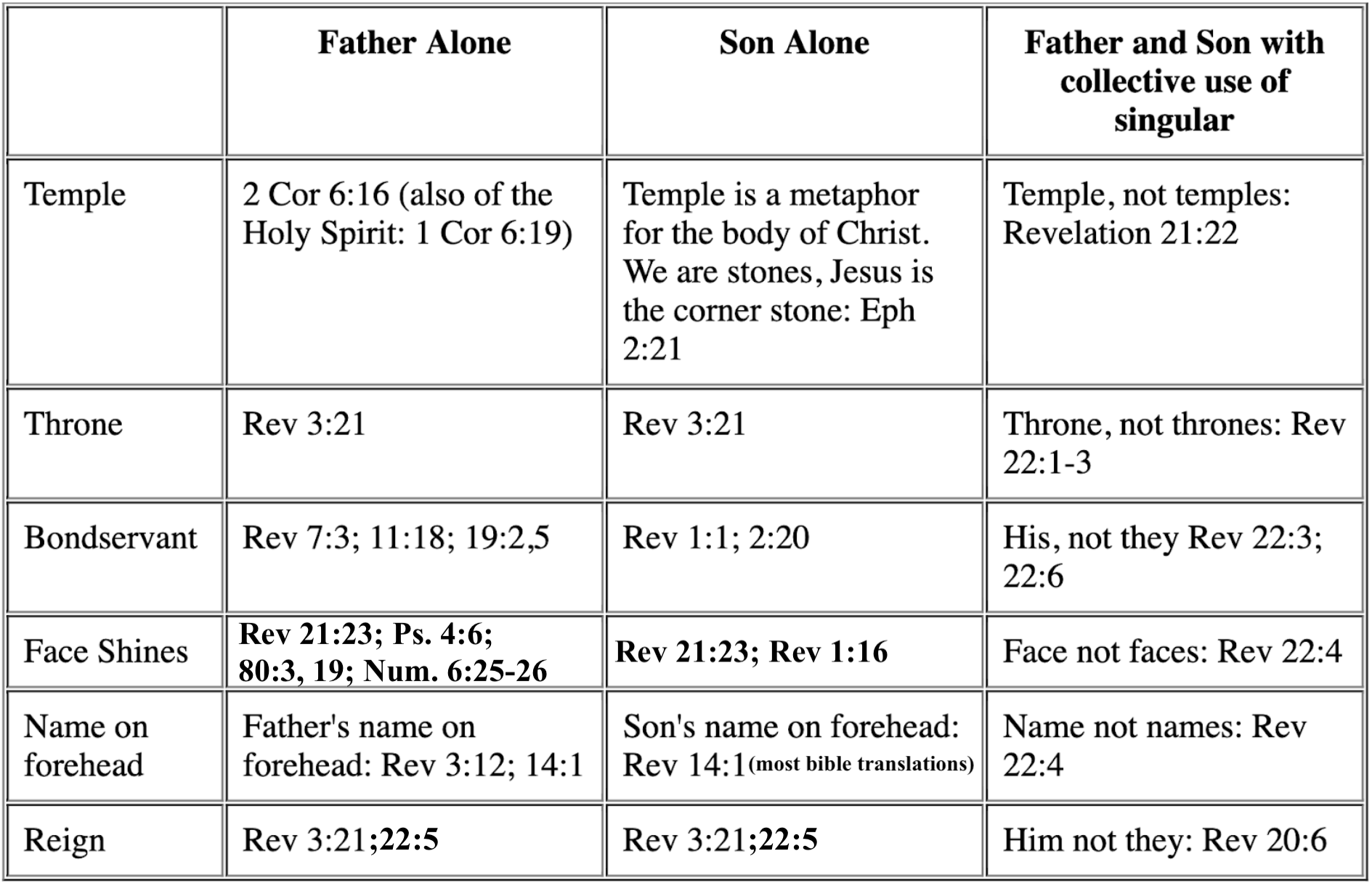
Here, two distinct Persons are referred to using singular pronouns, showing the ONENESS of the Father and the Son.
“4 And I saw thrones, and they sat upon them, and judgment was given unto them: and I saw the souls of them that were beheaded for the witness of Jesus, and for the word of God, and which had not worshipped the beast, neither his image, neither had received his mark upon their foreheads, or in their hands; and they lived and reigned with Christ a thousand years.5 But the rest of the dead lived not again until the thousand years were finished. This is the first resurrection.6 Blessed and holy is he that hath part in the first resurrection: on such the second death hath no power, but they shall be priests of God and of Christ, and shall reign with HIM[singular]a thousand years.”(Revelation 20:4-6)
The Father and Son are a single temple showing their ONENESS
“22 And I saw no temple therein: for the Lord God Almighty and the Lamb are the temple [singular] of it.” (Revelation 21:22)
The Father’s and Son’s throne is singular; singular pronouns are used for the Father and the Son, showing their ONENESS:
“And he shewed me a pure river of water of life, clear as crystal, proceeding out of the throne [singular] of God and of the Lamb.2 In the midst of the street of it, and on either side of the river, was there the tree of life, which bare twelve manner of fruits, and yielded her fruit every month: and the leaves of the tree were for the healing of the nations.3 And there shall be no more curse: but the throne [singular] of God and of the Lamb shall be in it; and HIS [not their] servants shall serve HIM [not them]:4 And they shall see HIS face [not their faces]; and HIS [not their] name shall be in their foreheads.” (Rev 22:1-4)
In Revelation 5, not only is Jesus alongside the Father, He is worshipped by all creatures, and the singular pronoun “Him” is used for the two Persons. Here again, we see the ONENESS of the Lamb and the Father:
“13 And every creature which is in heaven, and on the earth, and under the earth, and such as are in the sea, and all that are in them, heard I saying, Blessing, and honour, and glory, and power, be unto him that sitteth upon the throne, and unto the Lamb for ever and ever.14 And the four beasts said, Amen. And the four and twenty elders fell down and worshipped HIM that liveth for ever and ever.” (Revelation 5:13-14)
Revelation 5 also reveals the THREENESS of the Trinity. We see the Lamb who was slain (Jesus). In verse 7, this Lamb who was slain walks up to the one who is sitting on the throne. The identity of the one on the throne in heaven is God the Father. This is one of many scriptures that debunks Oneness Pentecostals who claim Jesus is the Father. They are apparently two distinct persons. Jesus is clearly seen taking the scroll out of the Father’s hand. Jesus is not the same person as the Father!
“6 And I beheld, and, lo, in the midst of the throne and of the four beasts, and in the midst of the elders, stood a Lamb as it had been slain, having seven horns and seven eyes, which are the seven Spirits of God sent forth into all the earth.7 And he came and took the book out of the right hand of him that sat upon the throne.”(Revelation 5:6-7)
What about the Holy Spirit? The seven Spirits referenced in Revelation 5 are likely the seven-fold descriptions of the Holy Spirit:
“And there shall come forth a rod out of the stem of Jesse, and a Branch shall grow out of his roots:2 And the spirit of the Lord shall rest upon him, the spirit of wisdom and understanding, the spirit of counsel and might, the spirit of knowledge and of the fear of the Lord;” (Isaiah 11:1-2)
The 7 fold descriptions of the Holy Spirit are listed in Isaiah 11:2. The prophecy reads that Jesus, who is the Root of Jesse (cf. Romans 15:12), would be empowered not by seven individual spirits but by the One Spirit, described seven ways:
In Isaiah 6, there is a plurality of Persons identified as Yahweh:
“6 In the year that king Uzziah died I saw also the Lord sitting upon a throne, high and lifted up, and his train filled the temple.2 Above it stood the seraphims: each one had six wings; with twain he covered his face, and with twain he covered his feet, and with twain he did fly.3 And one cried unto another, and said, Holy, holy, holy, is the Lord [YAHWEH] of hosts: the whole earth is full of his glory.4 And the posts of the door moved at the voice of him that cried, and the house was filled with smoke.5 Then said I, Woe is me! for I am undone; because I am a man of unclean lips, and I dwell in the midst of a people of unclean lips: for mine eyes have seen the King, the Lord [YAHWEH] of hosts.6 Then flew one of the seraphims unto me, having a live coal in his hand, which he had taken with the tongs from off the altar:7 And he laid it upon my mouth, and said, Lo, this hath touched thy lips; and thine iniquity is taken away, and thy sin purged.8 Also I heard the voice of the Lord, saying, Whom shall I send, and who will go for us? Then said I, Here am I; send me.9 And he said, Go, and tell this people, Hear ye indeed, but understand not; and see ye indeed, but perceive not.10 Make the heart of this people fat, and make their ears heavy, and shut their eyes; lest they see with their eyes, and hear with their ears, and understand with their heart, and convert, and be healed.” (Is. 6)
In Acts, it reads that the Holy Ghost, which the Old Testament identified as Yahweh, spoke to Isaiah.
“25 And when they agreed not among themselves, they departed, after that Paul had spoken one word, Well spake the Holy Ghost by Esaias the prophet unto our fathers,26 Saying, Go unto this people, and say, Hearing ye shall hear, and shall not understand; and seeing ye shall see, and not perceive:27 For the heart of this people is waxed gross, and their ears are dull of hearing, and their eyes have they closed; lest they should see with their eyes, and hear with their ears, and understand with their heart, and should be converted, and I should heal them.” (Acts 28:25-27)
In the book of John, it reads Isaiah saw Jesus (Isaiah Ch. 6), which the Old Testament identified as Yahweh:
“38 That the saying of Esaias the prophet might be fulfilled, which he spake, Lord, who hath believed our report? and to whom hath the arm of the Lord been revealed?39 Therefore they could not believe, because that Esaias said again,40 He hath blinded their eyes, and hardened their heart; that they should not see with their eyes, nor understand with their heart, and be converted, and I should heal them.41 These things said Esaias,when he saw his glory, and spake of him.” (John 12:38-41)
The baptismal formula in Matthew 28:19 seems to state both ONENESS and THREENESS by associating the three Persons equally and uniting them in one singular “name.” It places the Son and the Holy Spirit on the exact same level as the Father. By using a singular name to cover three distinct Persons, the formula implies a unity of essence. It suggests that the Father, Son, and Holy Spirit share a single divine identity and authority. If the Son were merely a human prophet and the Spirit were merely an impersonal force, placing them under the same singular “name” as the Almighty Father would be considered blasphemous in a strictly monotheistic Jewish context. Moreover, the name could be a reference to the Divine Name “YHWH” that Jews by that time stopped pronouncing out of reverence. They replaced it in speech with Adonai (Lord) and in writing/common reference with HaShem (The Name). By using the Divine Name for three Persons, Matthew maintains the monotheism of the Shema while expanding the understanding of God’s internal life. It’s as if he is saying: “There is one YHWH, and that YHWH is known as Father, Son, and Spirit.”
“19 Go ye therefore, and teach all nations, baptizing them in the name [singular] of the Father, and ofthe Son, and of the Holy Ghost:” (Matthew 28:19)
When Jesus was baptized, the Father and the Holy Spirit interacted with Him:
“16 When He had been baptized,Jesus came up immediately from the water; and behold, the heavens were opened to Him, and He saw the Spirit of God descending like a dove and alighting upon Him. 17 And suddenly a voice came from heaven, saying, “This is My beloved Son, in whom I am well pleased.”” (Matthew 3:16-17)
The apostle Peter traces salvation to the same triunal source:
“1 Peter, an apostle of Jesus Christ, to the strangers scattered throughout Pontus, Galatia, Cappadocia, Asia, and Bithynia, 2 elect according to the foreknowledge of God the Father, through sanctification of the Spirit, unto obedience and sprinkling of the blood of Jesus Christ: Grace unto you, and peace, be multiplied.” (1 Peter 1:1-2)
In Titus, it shows the Father, Son, and Holy Spirit working in unity to bring about salvation:
“4 But after that the kindness and love of God our Saviour toward man appeared,5 Not by works of righteousness which we have done, but according to his mercy he saved us, by the washing of regeneration, and renewing of the Holy Ghost;6 Which he shed on us abundantly through Jesus Christ our Saviour;” (Titus 3:4-6)
Other examples of the three Persons working together as One:
“And the angel answered and said unto her, The Holy Ghost shall come upon thee, and the power of the Highest shall overshadow thee: therefore also that holy thing which shall be born of thee shall be called the Son of God.” (Luke 1:35)
“But the Comforter, which is the Holy Ghost, whom the Father will send in my name, he shall teach you all things, and bring all things to your remembrance, whatsoever I have said unto you.” (John 14:26)
“But when the Comforter is come, whom I will send unto you from the Father, even the Spirit of truth, which proceedeth from the Father, he shall testify of me:” (John 15:26)
“Now he which stablisheth us with you in Christ, and hath anointed us, is God; who hath also sealed us, and given the earnest of the Spirit in our hearts.” (2 Corinthians 1:21-22)
“for through him we both have access by one Spirit unto the Father.” (Ephesians 2:18)
“That he would grant you, according to the riches of his glory, to be strengthened with might by his Spirit in the inner man; That Christ may dwell in your hearts by faith; that ye, being rooted and grounded in love,” (Ephesians 3:16-17)
“ If ye be reproached for the name of Christ, happy are ye; for the spirit of glory and of God resteth upon you: on their part he is evil spoken of, but on your part he is glorified.” (1 Peter 4:14)
“But ye, beloved, building up yourselves on your most holy faith, praying in the Holy Ghost, Keep yourselves in the love of God, looking for the mercy of our Lord Jesus Christ unto eternal life.” (Jude 20-21)
“How much more shall the blood of Christ, who through the eternal Spirit offered himself without spot to God, purge your conscience from dead works to serve the living God?” (Hebrews 9:14)
“Now there are diversities of gifts, but the same Spirit. And there are differences of administrations, but the same Lord. And there are diversities of operations, but it is the same God which worketh all in all.” (1 Corinthians 12:4-6)
Who dwells with born-again Christians? All three Persons of the Triune God do:
“17 even the Spirit of truth; whom the world cannot receive, because it seeth him not, neither knoweth him: but ye know him; for he dwelleth with you, and shall be in you. 18 I will not leave you comfortless: I will come to you. 19 Yet a little while, and the world seeth me no more; but ye see me: because I live, ye shall live also. 20 At that day ye shall know that I am in my Father, and ye in me, and I in you. 21 He that hath my commandments, and keepeth them, he it is that loveth me: and he that loveth me shall be loved of my Father, and I will love him, and will manifest myself to him.22 Judas saith unto him, not Iscariot, Lord, how is it that thou wilt manifest thyself unto us, and not unto the world? 23 Jesus answered and said unto him, If a man love me, he will keep my words: and my Father will love him, and we will come unto him, and make our abode with him.” (John 14:17-23)
The Apostolic Benediction:
“14 The grace of the Lord Jesus Christ, and the love of God, and the communion of the Holy Ghost, be with you all. Amen.” (2 Corinthians 13:14)
Trinitarian language used in this call to prayer:
“Now I beseech you, brethren, for the Lord Jesus Christ’s sake, and for the love of the Spirit, that ye strive together with me in your prayers to God for me;” (Romans 15:30)
The Angel of the LORD: A Christophany and Evidence for Plurality in the Godhead
The “Angel of the LORD” (Malakh YHWH) is not a mere created spirit, but a Christophany—a visible manifestation of God Himself. The Hebrew word malakh simply means “messenger” and does not necessarily refer to a created angelic being from heaven. It can describe human messengers or God Himself functioning as a messenger. The Old Testament presents a deliberate paradox: the Angel is identified as Yahweh, speaks as Yahweh, and receives worship as Yahweh—yet He is sent by Yahweh. This provides foundational evidence for a plurality of Persons within the one Godhead, which the New Testament explicitly identifies as the pre-incarnate Son, Jesus Christ. Direct Identification as God. In the Hebrew Bible, the Angel frequently shifts from third-person references (“God said”) to first-person speech (“I am God”) without any speaker change.
- The God of Bethel
In Genesis 31:11–13, the Angel of God speaks to Jacob in a dream: “I am the God of Bethel, where thou anointedst the pillar, and where thou vowedst a vow unto me.” Jacob accepts this reality where a messenger (the Angel) can legitimately declare, “I am the God of Bethel.” This suggests Jacob believed in a God who could “send Himself” or appear as His own representative. - Jacob’s Blessing
“The God before whom my fathers walked… the Angel who has delivered me from all harm” (Genesis 48:15-16).
By using a singular verb (yebarek / “may he bless”) to refer to both “God” and “the Angel,” which unites them under a single blessing, Jacob shows he did not view them as two separate gods (polytheism), but as a single divine source manifesting in two ways. To Jacob, “the Angel” was the functional, visible Person of the Godhead who intervened in his physical life. - The Sacrifice of Isaac
In Genesis 22:11–12, the Angel of the LORD calls from heaven: “Lay not thine hand upon the lad… for now I know that thou fearest God, seeing thou hast not withheld thy son, thine only son from me.” - The Burning Bush
Moses meets the Angel of the LORD in the burning bush (Exodus 3:2), but the speaker immediately identifies Himself as the Almighty: “And when the Lord saw that he turned aside to see, God called unto him out of the midst of the bush, and said, Moses, Moses. And he said, Here am I. And he said, Draw not nigh hither: put off thy shoes from off thy feet, for the place whereon thou standest is holy ground. Moreover he said, I am the God of thy father, the God of Abraham, the God of Isaac, and the God of Jacob. And Moses hid his face; for he was afraid to look upon God… I AM THAT I AM” (Exodus 3:4-6, 14). The narrator starts with the Angel but immediately switches the subject of the verbs to “the LORD” (YHWH) and “God” (Elohim). The One in the bush is simultaneously the Messenger and the Almighty.
The Theological Paradox: Visible vs. Invisible The Bible upholds a strict principle: “Thou canst not see my face: for there shall no man see me, and live” (Exodus 33:20). Yet multiple figures encounter the Angel and realize they have looked upon the face of God.
- Jacob’s Struggle
After wrestling with a “man” (identified as the Angel in Hosea 12:4), Jacob names the place Peniel: “For I have seen God face to face, and my life is preserved” (Genesis 32:30). Jacob had been crying out to the “God of my father Abraham” for deliverance from Esau. After the struggle, he recognizes that the Person he wrestled with was God—yet he clearly understood that God also remained the sovereign ruler of the heavens to whom he had been praying. He encountered a “Person” who carried the full authority and identity of Yahweh. - Gideon’s Fear
Upon realizing his visitor was the Angel, Gideon cries: “Alas, O Lord GOD! for because I have seen an angel of the LORD face to face” (Judges 6:22).
New Testament Identification: Jesus as the Messenger. The New Testament resolves the “Visibility Paradox” by explaining that the Son is the One who makes the invisible Father known.
- The Image of God
Paul describes Jesus as the “image of the invisible God” (Colossians 1:15). John 1:18 confirms: “No man hath seen God at any time; the only begotten Son, which is in the bosom of the Father, he hath declared him.” - The Messenger of the Covenant
Malachi 3:1 provides the prophetic link: “Behold, I will send my messenger [John the Baptist], and he shall prepare the way before me: and the Lord, whom ye seek, shall suddenly come to his temple, even the messenger of the covenant, whom ye delight in.” The word for “messenger” here is Malakh—the same as “Angel.” Jesus applies Malachi 3:1 to Himself and John the Baptist (Matthew 11:10 and Luke 7:27). Mark begins his Gospel by quoting Malachi 3:1 and Isaiah 40:3 together, proving that Jesus’ coming was the arrival of Yahweh to His people. - The Deliverer
Jude 1:5 states: “I will therefore put you in remembrance… how that the Lord [some manuscripts: Jesus], having saved the people out of the land of Egypt, afterward destroyed them that believed not.” The Old Testament attributes this physical rescue to the Angel (Judges 2:1). - They Tested the Sustainer
Paul says that the Israelites were sustained by Christ, and they tempted Christ in the wilderness (1 Corinthians 10:4; 9).
Divine Attributes of the Angel: To be identified as Yahweh, the Angel performs acts and possesses attributes reserved for God alone:
- Power to Forgive Sin
Yahweh warns Israel concerning the Angel: “Provoke him not; for he will not pardon your transgressions: for my name is in him” (Exodus 23:21). - Commands Worship or Reverence
He commands Moses (Exodus 3:5) and Joshua (Joshua 5:15) to loose their shoes, for the ground is made holy by His presence. Unlike created angels who refuse worship (Revelation 19:10), this Angel accepts it. - Sovereign Covenants
The Angel initiates and seals divine covenants. Because He can swear by no one greater, the Angel swears by Himself: “By myself have I sworn, saith the LORD… that in blessing I will bless thee” (Genesis 22:15–17; cf. Hebrews 6:13). - Creation and Omniscience
He promises to multiply Hagar’s seed exceedingly (Genesis 16:10)—a creative act—and is addressed by her as: “Thou God seest me” (Genesis 16:13). - The Exclusive Divine Name: “Wonderful” In Judges 13:17–18, when Manoah asks the Angel for His name so they can “do Him honor,” the Angel gives a response that links directly to Messianic prophecy:
“Why askest thou thus after my name, seeing it is secret (or Wonderful)?“ The Hebrew word pili or pil’î (Wonderful/Secret) is the same root used in Isaiah 9:6 for the Messiah (“And his name shall be called Wonderful…“). Created angels in the Bible have names that mean something about God (e.g., Michael = “Who is like God?”); this Angel has a name that is “too wonderful” for human comprehension, a trait reserved for the Infinite. - Acceptance of Sacrificial Fire In the cases of both Gideon (Judges 6:21) and Manoah (Judges 13:20), the Angel interacts with a meat/grain offering in a way that is exclusive to God. He touches the offering with a staff (Gideon) or ascends in the flame of the altar (Manoah). In both instances, the witnesses immediately panic because they realize they have seen God face-to-face. Created angels (like the one in Revelation 22:9) strictly command, “Worship God [not me].” This Angel directs the worship and the sacrifice to Himself.
- Direct Providential Leading (The Pillar of Cloud) In Exodus 14:19, the text identifies the “Angel of God” as the one physically leading the camp of Israel: “And the angel of God, which went before the camp of Israel, removed and went behind them; and the pillar of the cloud went from before their face, and stood behind them.“ Throughout the rest of the Pentateuch, it is Yahweh Himself who is said to be in the pillar (Exodus 13:21–22; 14:24; 33:9–10; 34:5; 40:34–38; Numbers 9:15–23; 14:14; Deuteronomy 1:33; 31:14–15). The Angel exercises the divine prerogative of being the “Shepherd of Israel,” actively judging and protecting (Isaiah 63:9) the nation through supernatural means.
These appearances reveal that the eternal Son has always been the visible face of the invisible God—preparing us to recognize Jesus as the Lord who has been present with His people from the beginning.
Note that the distinctive Old Testament appearances of the Angel of the LORD (as a Christophany) do not continue in the New Testament in the same form — because the eternal Son has now become flesh and dwelt among us (John 1:14). While the NT mentions angels of the Lord in other contexts, the pre-incarnate visible manifestations of the divine Messenger find their fulfillment in Jesus Himself.
All Three Persons of the Triune God work in unity and share the same attributes:
| The Father | The Son | The Holy Spirit | |
| Called God | Phil. 1:2 | John 1:1,14; Col. 2:9; Heb. 1:8-10; Phil. 2:6; Rev. 1:8 | 2 Samuel 23:2-3; Acts 5:3-4; Cf. Acts 7:51 with Ps. 78:17, 21, 40-42; Cf. Acts 28:25-27 with Isa. 6; Cf. Heb. 10:15-16 with Jer. 31:33; Cf. Heb 3:7-11 and Ps. 95:7-11 |
| Creator | Isaiah 64:8 | John 1:3; Col. 1:15-17; Heb. 1:8,10 | Gen. 1:2; Job 33:4, 26:13; Psalms 104:30 |
| Resurrects | 1 Thess. 1:10, Acts 2:32-33; Galatians 1:1 | John 2:18-19; 6:40; 10:17-18 | Rom. 8:11; 1 Peter 3:18 |
| Indwells | 2 Cor. 6:16; Eph. 3:19 | Col. 1:27; Rom. 8:10; John 14:20 | John 14:17; Eph. 5:18; 1 Cor. 6:19; 1 Cor. 3:16 |
| Everywhere | 1 Kings 8:27 | Matt. 28:20; Eph. 1:23, 4:10 | Ps. 139:7-10 |
| All-Knowing | 1 John 3:20 | John 16:30; 21:17 | 1 Cor. 2:10-11 |
| All-Powerful | Rev. 21:22 | Rev. 1:8; 1 Cor. 1:24 | Luke 4:14; Luke 24:49; 1 Cor. 2:4; Acts 1:8; Ps. 104:30 |
| Sanctifies | 1 Thess. 5:23 | Heb. 2:11 | 1 Pet. 1:2 |
| Life-Giver | Gen. 2:7: John 5:21 | John 1:3; 5:21, 10:10 | 2 Cor. 3:6,8 |
| Fellowships | 1 John 1:3 | 1 Cor. 1:9 | 2 Cor. 13:14; Phil. 2:1 |
| Eternal | Psalm 90:2 | John 1:1; Micah 5:1-2 | Heb. 9:14 |
| A Will | Luke 22:42 | Luke 22:42 | 1 Cor. 12:11 |
| Speaks | Matt. 3:17; Luke 9:35 | Luke 5:20; 7:48 | Acts 8:29; 11:12; 13:2; 28:25-28 |
| Love | John 3:16; 1 John 4:7 | Eph. 5:25 | Rom. 15:30 |
| Searches the Heart | Jer. 17:10 | Rev. 2:23 | 1 Cor. 2:10 |
| Speaks Through People | Exodus 4:12 | Luke 21:15 | Matt. 10:20; Luke 12:12; Mark 13:11 |
| Truth | Psalms 31:5 | John 14:6 | John 16:13; 1 John 5:6 |
| The Lord | Luke 10:21-22 | 1 Cor. 8:6 | 2 Cor. 3:17 |
| Own Mind | 1 Cor. 2:16 | 1 Cor. 2:16 | Rom. 8:27 |
| Called Good | Ps. 34:8; Mark 10:18 | Matt. 20:15; John 10:11; 1 Peter 2:3 (cf. Ps. 34:8) | Neh. 9:20; Ps. 143:10 |
| Holy | Isaiah 43:15 | Rev. 3:7; Heb. 7:26 | Rom. 1:4 |
| Teaches | 1 Thess. 4:9; Ps. 71:17 | Matt. 23:8 | John 14:26; 1 Cor. 2:13 |
| Wise/Wisdom | Ps. 147:5; Rom. 16:27; 11:33-34 | 1 Cor. 1:24; Col. 2:3 | Isaiah 11:2; Eph. 1:17 |
| Peace | Heb. 12:20 | Isaiah 9:6 | Eph. 4:3 |
| Reveals God | John 6:44 | Matt. 11:27 | John 15:26 |
Early church writers on the plurality of Persons of the one God Yahweh
50 – 110 AD The Didache: “And concerning baptism, baptize this way: Having first said all these things, baptize into the name of the Father, and of the Son, and of the Holy Spirit, Matthew 28:19 in living water. But if you have not living water, baptize into other water; and if you can not in cold, in warm. But if you have not either, pour out water thrice upon the head into the name of Father and Son and Holy Spirit. But before the baptism let the baptizer fast, and the baptized, and whatever others can; but you shall order the baptized to fast one or two days before.” (The Didache, Chapter 7)
70–125 Odes of Solomon: “Then all the seducers became headstrong and fled, and the persecutors became extinct and were blotted out.
And the letter became a large volume, which was entirely written by the finger of God.
And the name of the Father was upon it; and of the Son and of the Holy Spirit, to rule for ever and ever. Hallelujah.” (Ode 23:20–22)
c. 50–117 Ignatius: “Study, therefore, to be established in the doctrines of the Lord and the apostles, that so all things, whatsoever you do, may prosper both in the flesh and spirit; in faith and love; in the Son, and in the Father, and in the Spirit;” (The Epistle of Ignatius to the Magnesians, Ch. 13)
“Since, also, there is but one unbegotten Being, God, even the Father; and one only-begotten Son, God, the Word and man; and one Comforter, the Spirit of truth; and also one preaching, and one faith, and one baptism;” (The Epistle of Ignatius to the Philadelphians Chapter IV)
“…as being stones 1 Peter 2:5 of the temple of the Father, prepared for the building of God the Father, and drawn up on high by the instrument of Jesus Christ, which is the cross, John 12:32 making use of the Holy Spirit as a rope, while your faith was the means by which you ascended, and your love the way which led up to God.” (The Epistle of Ignatius to the Ephesians Chapter 9)
c. 96 First Clement: “Receive our counsel, and ye shall have no occasion of regret. For as God liveth, and the Lord Jesus Christ liveth, and the Holy Spirit, who are the faith and the hope of the elect, so surely shall he, who with lowliness of mind and instant in gentleness hath without regretfulness performed the ordinances and commandments that are given by God, be enrolled and have a name among the number of them that are saved through Jesus Christ, through whom is the glory unto Him for ever and ever. Amen.” (1Clem 58:2)
c. 120 – c. 180 Tatian the Syrian: “Then said Jesus unto them, I have been given all authority in heaven and earth; and as my Father has sent me, so I also send you. Go now into 6 all the world, and preach my gospel in all the creation; Matthew 28:19b and teach all the peoples, and baptize them in the name of the Father and the Son and the Holy Spirit…” (Diatessaron, Section LV)
140 AD Aristides: “[Christians] are they who, above every people of the Earth, have found the truth, for they acknowledgeGod, the creator and maker of all things, in the only-begotten Son and in the Holy Spirit” (Apology).
180 AD Irenaeus: “But the Son, eternally co-existing with the Father, from of old, yea, from the beginning, always reveals the Father to Angels, Archangels, Powers, Virtues…” (Against Heresies, Book II, ch. 30, section 9)
180 AD Irenaeus: “It was not angels, therefore, who made us, nor who formed us, neither had angels power to make an image of God, nor any one else, except the Word of the Lord, nor any Power remotely distant from the Father of all things. For God did not stand in need of these [beings], in order to the accomplishing of what He had Himself determined with Himself beforehand should be done, as if He did not possess His own hands. For with Him were always present the Word and Wisdom, the Son and the Spirit, by whom and in whom, freely and spontaneously, He made all things, to whom also He speaks, saying, “Let Us make man after Our image and likeness;” [Gen. 1:26]”(Against Heresies 4:20:1).
180 AD Irenaeus: “And therefore Isaiah himself, distinguishing the things already mentioned, again exclaims, “For the Spirit shall go forth from Me, and I have made every breath.” Thus does he attribute the Spirit as peculiar to God which in the last times He pours forth upon the human race by the adoption of sons; but [he shows] that breath was common throughout the creation, and points it out as something created. Now what has been made is a different thing from him who makes it. The breath, then, is temporal, but the Spirit eternal.” (Against Heresies Ch. 12)
180 AD Irenaeus: “And again, giving to the disciples the power of regeneration into God, He said to them, Go and teach all nations, baptizing them in the name of the Father, and of the Son, and of the Holy Ghost.
Matthew 28:19 For [God] promised, that in the last times He would pour Him [the Spirit] upon [His] servants and handmaids, that they might prophesy; wherefore He did also descend upon the Son of God, made the Son of man, becoming accustomed in fellowship with Him to dwell in the human race, to rest with human beings, and to dwell in the workmanship of God, working the will of the Father in them, and renewing them from their old habits into the newness of Christ.” (Against Heresies, Book III, Chapter 17)
150 AD Justin Martyr: “Then I replied, “Reverting to the Scriptures, I shall endeavor to persuade you, that He who is said to have appeared to Abraham, and to Jacob, and to Moses, and who is called God, is distinct from Him who made all things, — numerically, I mean, not [distinct] in will. For I affirm that He has never at any time done anything which He who made the world — above whom there is no other God — has not wished Him both to do and to engage Himself with.” (Dialog of Justin with Trypho, a Jew, ch 56)
150 AD Justin Martyr: “Hence are we called atheists. And we confess that we are atheists, so far as gods of this sort are concerned, but not with respect to the most true God, the Father of righteousness and temperance and the other virtues, who is free from all impurity. But both Him, and the Son (who came forth from Him and taught us these things, and the host of the other good angels who follow and are made like to Him), and the prophetic Spirit, we worship and adore, knowing them in reason and truth, and declaring without grudging to every one who wishes to learn, as we have been taught.” (The First Apology, ch 6)
150 AD Justin Martyr: “Our teacher of these things is Jesus Christ, who also was born for this purpose, and was crucified under Pontius Pilate, procurator of Judæa, in the times of Tiberius Cæsar; and that we reasonably worship Him, having learned that He is the Son of the true God Himself, and holding Him in the second place, and the prophetic Spirit in the third, we will prove. For they proclaim our madness to consist in this, that we give to a crucified man a place second to the unchangeable and eternal God, the Creator of all; for they do not discern the mystery that is herein, to which, as we make it plain to you, we pray you to give heed.” (The First Apology, ch 13)
150 AD Justin Martyr: “For, in the name of God, the Father and Lord of the universe, and of our Saviour Jesus Christ, and of the Holy Spirit, they then receive the washing with water. For Christ also said, Unless you be born again, you shall not enter into the kingdom of heaven.
John 3:5” (The First Apology, ch 61)
c. 120 – c. 180 AD Tatian: “Matthew 28:18b Then said Jesus unto them, I have been given all authority in heaven and earth; and as my Father has sent me, so I also send you. Go now into all the world, and preach my gospel in all the creation; Matthew 28:19b and teach all the peoples, and baptize them in the name of the Father and the Son and the Holy Spirit;” (The Diatessaron, Section 55)
c. AD 177, Athenagorus: “We acknowledge a God, and a Son, his Logos, and a Holy Spirit, united in essence—the Father, the Son, the Spirit—because the Son is the Intelligence, Reason, and Wisdom of the Father, and the Spirit an effluence, as light from fire.” (A Plea for the Christians 24)
c. AD 177, Athenagorus: The Holy Spirit Himself also, which operates in the prophets, we assert to be an effluence of God, flowing from Him, and returning back again like a beam of the sun. Who, then, would not be astonished to hear men who speak of God the Father, and of God the Son, and of the Holy Spirit, and who declare both their power in union and their distinction in order, called atheists? Nor is our teaching in what relates to the divine nature confined to these points; but we recognise also a multitude of angels and ministers, whom God the Maker and Framer of the world distributed and appointed to their several posts by His Logos, to occupy themselves about the elements, and the heavens, and the world, and the things in it, and the goodly ordering of them all. (A Please for the Christians Chapter 10)
c. AD 177, Athenagorus: “… that they know God and His Logos, what is the oneness of the Son with the Father, what the communion of the Father with the Son, what is the Spirit, what is the unity of these three, the Spirit, the Son, the Father, and their distinction in unity…” (A Plea for the Christians Chapter 12)
d. 183, Theophilus of Antioch: “In like manner also the three days which were before the luminaries, are types of the Trinity, of God, and His Word, and His wisdom.” (To Autolycus, Book II, Chapter 15)
190 AD Clement of Alexandria: “When [John] says: ‘What was from the beginning [1 John 1:1],’ he touches upon the generation without beginning of the Son, who is co-equal with the Father. ‘Was,’ therefore, is indicative of an eternity without a beginning, just as the Word Himself, that is the Son, being one with the Father in regard to equality of substance, is eternal and uncreated. That the word always existed is signified by the saying: ‘In the beginning was the Word’ [John 1:1].” (fragment in Eusebius History, Bk 6 Ch 14; Jurgens, p. 188)
190 AD Clement of Alexandria: ‘For both are one — that is, God. For He has said, “In the beginning the Word was in God, and the Word was God.” (The Instructor, Book 1, ch 8)
190 AD Clement of Alexandria: “I understand nothing else than the Holy Trinity to be meant; for the third is the Holy Spirit, and the Son is the second, by whom all things were made according to the will of the Father.” (Stromata, Book V, ch. 14)
190 AD Clement of Alexandria: “Luke 3:22. God here assumed the likeness
not of a man, but of a dove,
because He wished, by a new apparition of the Spirit in the likeness of a dove, to declare His simplicity and majesty.” (Framents, III)
200–265 AD Dionysius: “For it is essential that the Divine Word should be united to the God of all, and that the Holy Spirit should abide and dwell in God; and thus that the Divine Trinity should be reduced and gathered into one, as if into a certain head—that is, into the omnipotent God of all.” (Against the Sabellians 1)
200 AD Tertullian: (160-215) African apologist and theologian. He wrote much in defense of Christianity: “All the Scriptures give clear proof of the Trinity, and it is from these that our principle is deduced…the distinction of the Trinity is quite clearly displayed.” (Against Praxeas, ch 11)
200 AD Tertullian: “[God speaks in the plural ‘Let us make man in our image’] because already there was attached to Him his Son, a second person, his own Word, and a third, the Spirit in the Word….one substance in three coherent persons. He was at once the Father, the Son, and the Spirit.” (Against Praxeas, ch 12)
200 AD Tertullian: “Thus the connection of the Father in the Son, and of the Son in the Paraclete, produces three coherent Persons, who are yet distinct One from Another. These Three are, one essence, not one Person, as it is said, ‘I and my Father are One’ [John 10:30], in respect of unity of Being not singularity of number” (Against Praxeas, 25)
200 AD Tertullian: “That there are, however, two Gods or two Lords, is a statement which at no time proceeds out of our mouth: not as if it were untrue that the Father is God, and the Son is God, and the Holy Ghost is God, and each is God; but because in earlier times Two were actually spoken of as God, and two as Lord, that when Christ should come He might be both acknowledged as God and designated as Lord, being the Son of Him who is both God and Lord.
…
Besides, if, from that perfect knowledge which assures us that the title of God and Lord is suitable both to the Father, and to the Son, and to the Holy Ghost,” (Against Praxeas Chapter XIII).
200 AD Tertullian: “The Word, therefore, is both always in the Father, as He says, I am in the Father;
John 14:11 and is always with God, according to what is written, And the Word was with God;
John 1:1 and never separate from the Father, or other than the Father, since I and the Father are one.
John 10:30 This will be the prolation, taught by the truth, the guardian of the Unity, wherein we declare that the Son is a prolation from the Father, without being separated from Him. For God sent forth the Word, as the Paraclete also declares, just as the root puts forth the tree, and the fountain the river, and the sun the ray. For these are προβολαί, or emanations, of the substances from which they proceed. I should not hesitate, indeed, to call the tree the son or offspring of the root, and the river of the fountain, and the ray of the sun; because every original source is a parent, and everything which issues from the origin is an offspring. Much more is (this true of) the Word of God, who has actually received as His own peculiar designation the name of Son. But still the tree is not severed from the root, nor the river from the fountain, nor the ray from the sun; nor, indeed, is the Word separated from God. Following, therefore, the form of these analogies, I confess that I call God and His Word — the Father and His Son — two. For the root and the tree are distinctly two things, but correlatively joined; the fountain and the river are also two forms, but indivisible; so likewise the sun and the ray are two forms, but coherent ones. Everything which proceeds from something else must needs be second to that from which it proceeds, without being on that account separated. Where, however, there is a second, there must be two; and where there is a third, there must be three. Now the Spirit indeed is third from God and the Son; just as the fruit of the tree is third from the root, or as the stream out of the river is third from the fountain, or as the apex of the ray is third from the sun. Nothing, however, is alien from that original source whence it derives its own properties. In like manner the Trinity, flowing down from the Father through intertwined and connected steps, does not at all disturb the Monarchy, while it at the same time guards the state of the Economy” (Against Praxeas Chapter 8).
200 AD Tertullian: Meanwhile He has received from the Father the promised gift, and has shed it forth, even the Holy Spirit— the Third Name in the Godhead, and the Third Degree of the Divine Majesty… (Against Praxeas Ch. 12).
200 AD Tertullian: “For the very Church itself is, properly and principally, the Spirit Himself, in whom is the Trinity of the One Divinity—-Father, Son, and Holy Spirit. (Chapter 21)
200 AD Tertullian: “For the law of baptizing has been imposed, and the formula prescribed: “Go,” He saith, “teach the nations, baptizing them into the name of the Father, and of the Son, and of the Holy Spirit.” (On Baptism (De Baptismo), Chapter 13)
200 AD Hippolytus: “Beside Him there was nothing; but He [God], while existing alone, yet existed in plurality.” (Against Noetus, Part 10)
200 AD Hippolytus: “For who will not say that there is one God? Yet he will not on that account deny the economy (i.e., the number and disposition of persons in the Trinity).” (Against The Heresy Of One Noetus)
200 AD Hippolytus: “As far as regards the power, therefore, God is one. But as far as regards the economy there is a threefold manifestation, as shall be proved afterwards when we give account of the true doctrine” (Against The Heresy Of One Noetus)
200 AD Hippolytus: “She hath mingled her wine” in the bowl, by which is meant, that the Saviour, uniting his Godhead, like pure wine, with the flesh in the Virgin, was born of her at once God and man without confusion of the one in the other. “And she hath furnished her table:” that denotes the promised knowledge of the Holy Trinity.” (Hippolytus on Prov 9:1, fragment, “Wisdom hath builded her house.”)
200 Ad Hippolytus: “In God the Father Almighty; and the recipient shall say, Amen. Then: In the Lord Jesus Christ; [and he shall say, Amen. Then: In] [the] Holy Ghost and the holy church; and he shall say, Amen. So it shall be done to each.” (THE APOSTOLIC TRADITION
OF HIPPOLYTUS, Part II)
c. 210 – 258 Cyprian: “Finally, when, after the resurrection, the apostles are sent by the Lord to the heathens, they are bidden to baptize the Gentiles in the name of the Father, and of the Son, and of the Holy Ghost.
” (Epistle 72)
225 AD Origen: “Nothing in the Trinity can be called greater or less, since the fountain of divinity alone contains all things by His word and reason, and by the Spirit of His mouth sanctifies all things which are worthy of sanctification.” (De Principis, Book I, ch. 3, section 7)
225 AD Origen: “Saving baptism was not complete except by the authority of the most excellent Trinity of them all, i.e., by the naming of the Father, the Son, and the Holy Spirit.” (De Principis, Book I, ch. 3, section 2)
225 AD Origen: “We worship one God, the Father and the Son.” (Against Celsus, Book VIII, section 12)
250 AD Cyprian: “The Lord says, I and the Father are one;
John 10:30 and again it is written of the Father, and of the Son, and of the Holy Spirit, And these three are one.
1 John 5:7.” (Treatise 1:6)
262 AD Gregory Thaumaturgus: “But some treat the Holy Trinity in an awful manner, when they confidently assert that there are not three persons, and introduce (the idea of) a person devoid of subsistence. Wherefore we clear ourselves of Sabellius, who says that the Father and the Son are the same [Person] . . . We forswear this, because we believe that three persons–namely, Father, Son, and Holy Spirit–are declared to possess the one Godhead: for the one divinity showing itself forth according to nature in the Trinity establishes the oneness of the nature” (A Sectional Confession of Faith 8).
262 AD Gregory Thaumaturgus: “But if they say, ‘How can there be three Persons, and how but one Divinity?’ we shall make this reply: That there are indeed three persons, inasmuch as there is one person of God the Father, and one of the Lord the Son, and one of the Holy Spirit; and yet that there is but one divinity, inasmuch as . . . there is one substance in the Trinity” (A Sectional Confession of Faith, 14).
262 AD Gregory Thaumaturgus: “We therefore acknowledge one true God, the one First Cause, and one Son, very God of very God, possessing of nature the Father’s divinity,–that is to say, being the same in substance with the Father; and one Holy Spirit, who by nature and in truth sanctifies all, and makes divine, as being of the substance of God. Those who speak either of the Son or of the Holy Spirit as a creature we anathematize” (A Sectional Confession of Faith 15).
262 AD Gregory Thaumaturgus: “There is one God, the Father of the living Word, who is His subsistent Wisdom and Power and Eternal Image: perfect Begetter of the perfect Begotten, Father of the only-begotten Son. There is one Lord, Only of the Only, God of God, Image and Likeness of Deity, Efficient Word, Wisdom comprehensive of the constitution of all things, and Power formative of the whole creation, true Son of true Father, Invisible of Invisible, and Incorruptible of Incorruptible, and Immortal of Immortal and Eternal of Eternal . . . There is a perfect Trinity, in glory and eternity and sovereignty, neither divided nor estranged. Wherefore there is nothing either created or in servitude in the Trinity; nor anything superinduced, as if at some former period it was non-existent, and at some later period it was introduced. And thus neither was the Son ever wanting to the Father, nor the Spirit to the Son; but without variation and without change, the same Trinity abides ever” (Declaration of Faith).
305 AD Methodius: “For the kingdom of the Father, of the Son, and of the Holy Ghost, is one, even as their substance is one and their dominion one. Whence also, with one and the same adoration, we worship the one Deity in three Persons, subsisting without beginning, uncreated, without end, and to which there is no successor. For neither will the Father ever cease to be the Father, nor again the Son to be the Son and King, nor the Holy Ghost to be what in substance and personality He is. For nothing of the Trinity will suffer diminution, either in respect of eternity, or of communion, or of sovereignty” (Oration on the Psalms 5).
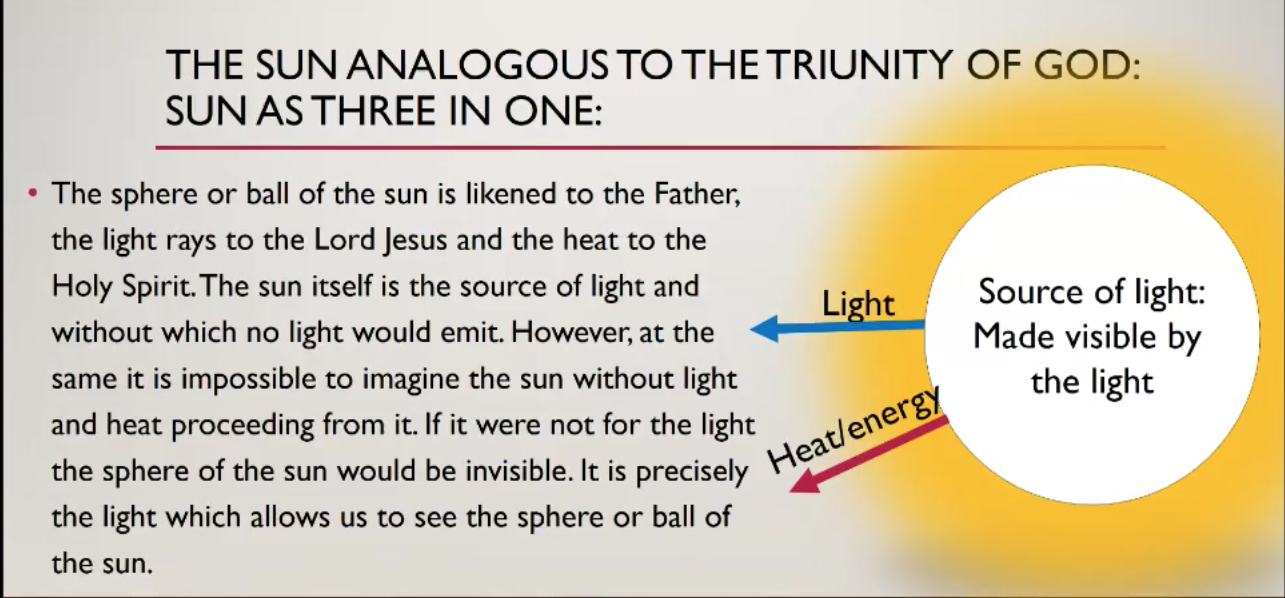
307 AD Lactantius: “When we speak of God the Father and God the Son, we do not speak of them as different, nor do we separate them, because the Father cannot exist without the Son, nor can the Son be separated from the Father, since the name of ‘Father’ cannot be given without the Son, nor can the Son be begotten without the Father. . . . [T]hey both have one mind, one spirit, one substance; but the former [the Father] is as it were an overflowing fountain, the latter [the Son] as a stream flowing forth from it. The former as the sun, the latter as it were a ray [of light] extended from the sun” … “We, on the other hand, are [truly] religious, who make our supplications to the one true God. Some one may perhaps ask how, when we say that we worship one God only, we nevertheless assert that there are two, God the Father and God the Son–which assertion has driven many into the greatest error . . . [thinking] that we confess that there is another God, and that He is mortal. . . . [But w]hen we speak of God the Father and God the Son, we do not speak of them as different, nor do we separate each, because the Father cannot exist without the Son, nor can the Son be separated from the Father” (Divine Institutes , 4:28-29).
Addendum
It is often claimed by anti-Trinitarians—especially Muslims and unitarian “Christians” — that no Jew before the time of Jesus believed YHWH to be multi-personal in any meaningful sense, making the Christian doctrine of the Trinity (or even a binitarian Godhead) a later innovation. But was this really the case?
Alan Franklin Segal (August 2, 1945 – February 13, 2011) was a scholar of ancient religions, specializing in the relationship between Judaism and Christianity. He wrote:
“… It became clear that ‘two powers in heaven’ was A VERY EARLY CATEGORY OF HERESY, EARLIER THAN JESUS, if Philo is a trustworthy witness, and one of the basic categories by which the rabbis perceived the new phenomenon of Christianity. It was one of the central issues over which the two religions separated…” (Segal, Two Powers in Heaven – Early Rabbinic Reports about Christianity and Gnosticism, p. ix)
And:
“Though it was difficult to date the rabbinic traditions accurately in many cases, the results showed that the earliest heretics believed in two complementary powers in heaven while only later could heretics be shown to believe in two opposing powers in heaven. The extra-rabbinic evidence allowed the conclusion that the traditions were earlier than the first century. Furthermore, in comparing the literature, it was possible to define a number of dangerous scriptural interpretations central to the heresy and show how the rabbis countered them by bringing in other scriptures which unambiguously stated God’s unity. From this evidence it became clear that the basic heresy involved interpreting scripture to say that a principal angelic or hypostatic manifestation in heaven was equivalent to God. This heresy was combatted by the rabbis with verses from Deuteronomy and Isaiah which emphasized God’s unity.” (Ibid., p. x)
Segal wrote about Scriptures used by alleged “heretics” to support their view that there were at least two Powers in heaven. He quotes and comments on the rabbinic traditions that mention these problematic texts:
“PASSAGE 8
Tanhuma Kadoshim 4 (Buber, 37a) 2
“Another interpretation: Say to the whole congregation of the Children of Israel “You shall be holy for I am Holy”. (Lev. 19:2) The Holy One Blessed Be He told them “Be holy for I am Holy in every matter. Look at what is written: ‘For God is Holy (pl.)’” (Josh. 24:19). What is the meaning of “For God is Holy?” This verse gave an opportunity to the heretics for it appeared like two powers. The heretics asked R. Simlai about “For the Lord is Holy (pl.)” – “You yourselves don’t say that He is one power, rather there are two powers.” He said to them “What fools the world contains! Look at what is written: ‘For He is a Holy God.’ If it had said ‘They are Holy Gods,’ you might have thought there were two powers.”
“This passage is recorded in Tanhuma, a later document which is sometimes believed to contain ancient traditions… These heretical arguments were seen to be of the same type by the rabbis, confirming what we already know–that “two powers” had become a conventional term for a variety of heresies whenever scripture could be interpreted to imply plural forms for divinity. Here the argument seems to be confined to grammatical plurals.
“However, there is nothing in the traditions to indicate that the heretics themselves would have argued solely from plural grammar. Wherever we know that a scriptural passage was used by heretics, the arguments of the heretics were much more complicated.
“The most complete version of this particular tradition is found in b. Sanhedrin 38b where almost all of this type of dangerous scriptural passages were brought together.
“R. Yohanan said: in all the passages which the minim have taken (as grounds) for their heresy, their refutation is found near at hand. Thus: let us make man in our image (Gen. 1:26)—and God created (sing) man in His own image (ibid., 27); Come, let us go down and there confound their language (Gen. 11:7)—and the Lord came down (sing) to see the city and the tower (ibid., 5). Because there were revealed (Gen. 35:7) to him, God. Unto God who answers me in the day of my distress (ibid., 3); For what great nation is there that has God so nigh (pl.) unto it, as the Lord our God is (unto us) whenever we call upon Him (Dt. 4:7). And what one nation in the earth is like Thy people, like Israel whom God went (pl.) to redeem for a people unto Himself (sing.) (2 Sam. 7:23). ‘Til thrones were placed and [one that was] the ancient of days did sit (Dan. 7:9).
“… A grammatical plural form in scripture is used by heretics to demonstrate duality or plurality in the deity. The rabbi suggests that the remedy to the heresy, always a grammatical singular, invariably occurs close to the plurals, proving the heretical doctrine wrong. Some of the dangerous scriptures must reflect real arguments between orthodox and heretical communities, but other passages may have been added purely by analogy, as the tradition grew. More importantly, we have no evidence that any actual heretical argument took the form in which it is reported. While the heretics might have used the passage, their beliefs were no doubt more sophisticated than the rabbis reported.” (Segal, TWO POWERS IN HEAVEN: Early Rabbinic Reports about Christianity and Gnosticism, Chapter Eight. How Many Powers Created the World?, pp. 121-123)
Segal also wrote:
“One passage says: His throne was fiery flames (Dan. 7:9) and another passage says: Until thrones were placed; and One that was ancient of days did sit—there is no contradiction; One (throne) for Him, and one for David: this is the view of R. Akiba. Said R. Yosi the Galilean to him: Akiba, how long will you treat the divine presence as profane! Rather, one for justice and one for grace. Did he accept (this explanation) from him, or did he not accept it?—come and hear: One for justice and one for grace; this is the view of R. Akiba. 21
“These two rabbis were perplexed by the seeming contradiction in the verses. In one place, more than one throne is indicated by the plural form of the noun. In another place “His (God’s) throne was fiery flames” implies only one throne. Does this mean that the ‘son of man’ in the next verse was enthroned next to God? Rabbi Akiba (110-135 C.E.) affirms the possibility, stating that the other throne was for David. Akiba must be identifying the ‘son of man’ with the Davidic messiah. Nor was R. Akiba alone in the rabbinic movement in identifying the figure in heaven as the messiah. There is some evidence that Judaism contained other traditions linking these verses in Daniel with the messiah.” (Segal, TWO POWERS IN HEAVEN: Early Rabbinic Reports about Christianity and Gnosticism, Chapter Two. Conflicting Appearances of God, pp. 47-48)
“21. b. Hag. 14a Tr. Epstein. Cf. also b. Sanhedrin 38a where other rabbis are said to oppose R. Akiba…” (Ibid., p. 47)
And:
“… R. Hiyya b. Abba answers in Aramaic, rather than in Hebrew, that if a heretic says that there are ‘two gods’ based on Dan. 7:9f., one is to remind him that God stated that He is the same at the Sea and at Sinai…” (Ibid., p. 42)
The work of Alan Segal provides a devastating blow to the claim that a “multi-personal” understanding of God was a late, Hellenistic corruption of a strictly unitarian Judaism. Instead, Segal’s research demonstrates that the concept of “Two Powers in Heaven” was not only present in pre-Christian Judaism but was a widespread and tolerated theological framework derived directly from the exegesis of the Hebrew Scriptures.
Peter Schäfer (born June 29, 1943) is a prolific German scholar of ancient religious studies who has made contributions to the field of ancient Judaism and early Christianity. He wrote:
“Among the most popular clichés not only in Jewish and Christian theology but also in popular religious belief is the assumption that Judaism is the classic religion of monotheism, and if Judaism did not in fact invent monotheism, then it at least ultimately asserted it.1 Nothing summarizes this basic assumption better than the affirmation in Deuteronomy 6:4: “Hear, O Israel: The Lord is our God, the Lord is one.” As the Shema‘ Yisrael, it became the solemn daily prayer, with which many Jewish martyrs went to their death. Christianity, as this narrative continues, adopted this Jewish monotheism, but quickly expanded it with the idea of the incarnation of God’s son, the Logos, and finally watered it down entirely with the doctrine of three divine persons, the Trinity. In this view, Judaism was thus compelled to limit itself even more to the abstract concept of the one and only God. This God could then easily degenerate into the caricature of the Old Covenant’s God, who receded ever farther into the distance and against whom the message of the New Covenant could set itself apart with all the more radiance. Judaism, according to this narrative, had no alternative but to assume its assigned role, as there was never a serious, much less balanced dialogue between mother and daughter religion.
“We know today that pretty much none of this ideal picture stands up to historical review.2 Some potential objections have meanwhile become generally accepted, while others are still extremely controversial and the subject of heated discussion. With respect to biblical monotheism, today it can be read in all the related handbooks that this tends to be an ideal type in religious history rather than a historically verifiable reality.3 The term “monotheism” is a modern coinage, first documented in 1660 by the English philosopher Henry More, who used it to characterize the ideal pinnacle of faith in God. Well into the twentieth century the term continued to play a key role in two opposing models of development of religions: either monotheism was considered the unsurpassable end point in a long chain of religions, which at the dawn of time began with all kinds of “primitive” forms, in order then to be spiritualized in increasingly “pure” forms (the evolutionary model), or on the contrary, it was the original ideal form of religion, which over time continued to degenerate and ultimately lost itself in polytheistic diversity (the decadence model). Both models have long since become obsolete in religious history. Monotheism is neither at the beginning of “religion” nor does it represent the final apex of a linear development. What makes more sense is a dynamic model that dispenses with value judgments, and moves between the two poles of “monotheism” and “polytheism,” including numerous configurations and combinations that crystallized at different times and in different geographic regions.
“This also means that Jewish monotheism was not “achieved” at a certain point in time in the history of the Hebrew Bible,* in order thereafter only to be defended against attacks from “the outside.” This linear developmental model is also outdated. Bible scholars today paint a multifaceted picture of the idea of God in ancient Israel, in which various gods stand side by side and compete with one another. Israel’s own God YHWH** had to assert himself not only against numerous powerful spirits and demons but especially also against the deities of the Ugaritic and Canaanite pantheon, headed by the old god El and his subordinate, the young war god Ba‘al. The strategy of the authors and editors of the Hebrew Bible to let competing gods be subsumed in YHWH was not always successful.4 Ba‘al worshippers proved to be particularly resistant to this, as shown by the confrontation of the prophet Elijah against the cult of Ba‘al, as demanded by King Ahab in the ninth century BCE (1 Kings 18). The prophet Hosea still felt compelled in the eighth century BCE to take action against the Ba‘al worship at the land’s high places (Hos. 2).”
…
“The conflict between a theology that wished to acknowledge only YHWH as God and a religious tradition with many goddesses and gods came to a head in the crisis triggered by the Babylonian exile. While the “angel of the Lord” (Exod. 23:20–33), who is in competition with YHWH and would play a large role in rabbinic commentaries, has been placed by Bible scholarship in an earlier layer in the Hebrew Bible, the indefinite plural in the first story of creation—“Then God said, ‘Let us make humankind in our image, according to our likeness” (Gen. 1:26)—is part of the priestly account, which was probably written during the exile. For this reason, the priestly account of creation may well imply a “monotheistic confession,”7 despite the use of a plural from the mouth of the same God, but this confession, as the rabbis experienced during the confrontation with their Christian, Gnostic, or also inner-Jewish opponents, was anything but uncontested. The same is true for the apocalyptic as well as the wisdom literature of postexilic Judaism of the Second Temple, both belonging to the canonical and especially also noncanonical literature, which will be the subject of the first part of this book. This is not simply a matter of an angelology, which places itself, as a “buffer” as it were, between the ostensible “distance of a God becoming increasingly transcendent” and his earthly people, Israel,8 yet more directly and tangibly, it is about the return of not many but at least two gods in the Jewish heaven.
“No less problematic about the ideal picture sketched above are the roles assigned to Christianity and the rabbinic Judaism* that was becoming established at the same time. There is no doubt that the Christianity of the New Testament and the early church fathers of the first centuries CE adopted Jewish monotheism however, it was not a “pure” monotheism matured to eternal perfection but rather the “monotheism” that had developed in the postexilic period in the later canonical literature of the Hebrew Bible and noncanonical writings, the so-called apocrypha** and pseudepigrapha.* The New Testament took up these traditions that existed in Judaism, and did not reinvent but instead expanded and deepened them. The elevation of Jesus of Nazareth as the firstborn before all creation, the God incarnate, Son of God, Son of Man, the Messiah: all these basic Christological premises ARE NOT PAGAN or other kinds of aberrations; THEY ARE ROOTED IN SECOND TEMPLE JUDAISM, regardless of their specifically Christian character. This is not changed by the fact that the divine duality of father and son led, far beyond the New Testament, to the Trinity of Father, Son, and Holy Spirit, which would then be codified in the First Councils of Nicaea (325 CE) and Constantinople (381 CE).
“The Christological and then also the Trinitarian intensification of the concept of God in Christianity by no means implies that rabbinic Judaism forgot or repressed its own roots in Second Temple Judaism. Quite to the contrary. Recent research shows with increasing clarity that the Judaism of the first century CE did not ossify in lonely isolation and self-sufficiency; rather, only through constant discourse with the evolving Christianity did it become what we refer to today as rabbinic Judaism and the Judaism of early Jewish mysticism. Just as Christianity emerged through recourse to and controversy with Judaism, so too the Judaism of the period following the destruction of the Second Temple was not a Judaism identical to that of its early precursors but instead developed in dialogue and controversy with Christianity. Therefore, I prefer to define the relationship between Judaism and Christianity not as linear from the mother to the daughter religion but rather as a dynamic, lively exchange between two sister religions—a process in which the delimitation tendencies steadily grew, leading ultimately to the separation of the two religions. The second part of this book is devoted to this dialectic process of exchange and delimitation…
“The title of this examination, Two Gods in Heaven, is pointedly based on the rabbinic phrase “two powers in heaven” (shetei rashuyyot), which clearly implies two divine authorities side by side. This does not refer to two gods who fight each other in a dualistic sense (“good god” versus “evil god”), as we are familiar with primarily from Gnosticism, but rather two gods who rule side by side and together—in different degrees of agreement and correlation. Scholarship has developed the term “binitarian” to describe this juxtaposition of two powers or gods, analogous to the term “trinitarian” associated with Christian dogma.9
“The theme of two divine authorities in the Jewish heaven is not new. Almost all pertinent studies follow the key rabbinic concept of “two powers,” concentrating on the period of classical rabbinic Judaism. After the pioneering work of R. Travers Herford, the revised dissertation of Alan Segal, Two Powers in Heaven, is considered a milestone in more recent research.10 Despite their indisputable merits, however, both works set out from the premise that the rabbis, in their polemics against “two powers,” were referring to clearly identifiable “heretic sects” that were beginning to break off from “orthodox” Judaism. For Herford, it was overwhelmingly Christianity that incurred the wrath of the rabbis, whereas Segal attempted to address an entire spectrum of pagans, Christians, Jewish Christians, and Gnostics. But ultimately, even Segal’s Two Powers in Heaven remains caught in the methodological straitjacket of dogmatically established “religions” that defended themselves against “sects” and “heresies.”…
“Early Judaism—that is, the period prior to rabbinic Judaism and the New Testament—has up to now been examined predominantly by Christian New Testament scholars. With his seminal contribution on the Son of God, Martin Hengel opened up an entire field of research that has since gained considerable influence especially in Anglo-Saxon research under the heading of “High Christology.”15 “High Christology” is understood as referring to the Christology of the New Testament that specifically addresses the divinity of Jesus, in contrast to “Low Christology,” which is primarily concerned with Jesus’s human nature. If the writings of the New Testament—that is, long before the later dogmatic statements by the church fathers—already speak of the idea of Jesus’s divinity and his being worshipped as a second God next to God the Father (which is generally affirmed), how does this relate to the supposed biblical and early Jewish monotheism?
“Diverse research literature has meanwhile emerged on this, covering the range between these two poles:16 from, on the one hand, advocates of an exclusive monotheism who view early Judaism as bearing witness only to a strict belief in the one and only God, through, on the other hand, all possible stages of an inclusive and fluid monotheism up to authors who recognize authentic early Judaism in the idea of two Gods side by side.17 The assessment of the divinity of Jesus then results from its relation to the varying degrees of early Jewish monotheism: almost all authors, including the exclusive monotheists, meanwhile concede that numerous mediator figures (angels, patriarchs, personified divine attributes, etc.) were known to early Judaism, but they remain at the level of divine agents and do not explain the undisputed divinity of Jesus. The latter results, as Larry Hurtado has stated with particular emphasis, exclusively from the cultic worship and veneration of Jesus, which is what comprises the “binitarian mutation” in Jewish monotheism that is characteristic of early Christianity. According to Richard Bauckham, a contemporary ally of Hurtado, the ostensibly strict early Jewish monotheism can only be overcome when Jesus becomes identical with the one and only Jewish God.18 The messiah Jesus is not a second semidivine figure but instead God himself. This is without doubt the most radical deduction from an extreme Jewish monotheism.19” (Schäfer, Two Gods in Heaven: Jewish Concepts of God in Antiquity, Introduction: One God?, pp. 1-8)
Professor Elliot R. Wolfson comments on the significance of the angel bearing God’s name within himself and its impact on Jewish understanding and exegesis:
“The textual proofs for the incarnation of the divine in the angelic figure are found in passages where there is a deliberate confusion between the angel of God and divinity itself (Gen. 16:9-13, 18:2, 21:7, 22:11, 31:11, 33:11-13; Ex. 3:2ff., 14:19, 23:21, 32:34; Jos. 5:13-15; Jud. 2:1, 4, 5:23, 6:11ff., 13:3ff.; Is. 63:9; Ps. 34:8). In such instances, the shift in the narrative from God to the angel points to the fact THAT GOD APPEARS IN THE GUISE OF AN ANGEL. One scriptural verse that is extremely significant for understanding this ancient Israelite conception is God’s statement that the Israelites should give heed to the angel whom he has sent before them and not rebel against him, for his name is in him (Ex. 23:21). The line separating the angel and God IS SUBSTANTIALLY BLURRED, for by bearing the name, WHICH SIGNIFIES THE POWER OF THE DIVINE NATURE, the angel IS THE EMBODIMENT OF GOD’S PERSONALITY. To possess the name is not merely to be invested with divine authority; it means that ONTOLOGICALLY the angel is the incarnational presence of the divine manifest in the providential care of Israel … This notion, attested in older Jewish mystical texts as well, is consistent with what one finds in the biblical texts themselves; that is, the ancient Israelite belief was THAT GOD COULD APPEAR AS AN ANGELIC PRESENCE TO HUMAN BEINGS, and the shape this presence took WAS THAT OF AN ANTHROPOS. The angelic form, therefore, is the garment (as later kabbalists expressed the matter) in which the divine is clad when it is manifest in the world in the shape of an anthropos. Clearly, this phenomenon, which is notably similar to the Christological identification of Jesus as THE GLORIOUS ANGEL, should be classified as an example of incarnation as distinct from anthropomorphization.
“… I would argue that the possibility of God assuming the form of an angel is one of the ground myths that informs the liturgical imagination in rabbinic praxis. The implication of the biblical conception is made explicit in several midrashic sources. Thus, in one context, the matter is related exegetically to the expression ‘captain of the Lord’s host’ (Jos. 5:14): ‘I am the captain from above, and in every place that I am seen the Holy One, blessed be he, is seen.’ The particular angelic being who serves as the chief of the celestial host is not identified in this text, but the implication of the passage is clear: from a theophanic perspective, the highest angel and God ARE PHENOMENALLY INTERCHANGEABLE, for in every place that the former appears THE LATTER APPEARS. It is not only that the two belong together, BUT THAT THEY RESEMBLE ONE ANOTHER TO THE POINT THAT THE ONTOLOGICAL DIFFERENCE BETWEEN THE TWO IS OBSCURED…” (Christianity in Jewish Terms, ed. Tikva Frymer-Kensky, David Novak, Peter Ochs, David Fox Sandmel, Michael A. Signer, pp. 244-245)
Daniel Boyarin (born 1946) is an Israeli–American academic and historian of religion. He is the Hermann P. and Sophia Taubman Professor of Talmudic Culture in the Departments of Near Eastern Studies and Rhetoric at the University of California, Berkeley. He wrote:
“The ideas of Trinity and incarnation, or certainly the germs of those ideas, were already present among Jewish believers well before Jesus came on the scene to incarnate himself.”
(Daniel Boyarin, The Jewish Gospels: The Story of the Jewish Christ, p. xiii (Preface))
Boyarin also wrote:
“In this remarkable text, we find the prophet Daniel having a vision in which there are two divine figures, one who is depicted as an old man, an Ancient of Days, sitting on the throne. We have been told, however, that there is more than one throne there, and sure enough a second divine figure, in form ‘like a human being,’ is brought on the clouds of heaven and invested by the Ancient of Days in a ceremony very much like the passing of the torch from elder king to younger in ancient Near Eastern royal ceremonial and the passing of the torch from older gods to younger ones in their myths…
“We can begin to see here a notion about redemption that is quite different from the expectation of the restoration of a Davidic king on the throne of Jerusalem. What this text projects is a second divine figure to whom will be given eternal dominion of the entire world, of a restored entire world in which this eternal king’s guidance and rule will be in accord, completely and finally, with the will of the Ancient of Days as well. Although this Redeemer figure is not called the Messiah–this name for him will have to wait for later reflections on this Danielic vision, as we shall see below–it brings us close to at least some of the crucial characteristics of the figure named later the Messiah or the Christ.
What are these characteristics?
- He is divine.
- He is divine in human form.
- He may very well be portrayed as a younger-appearing divinity than the Ancient of Days.
- He will be enthroned on high.
- He is given power and dominion, even sovereignty on earth.
“All of these are characteristics of Jesus Christ as he will appear in the Gospels, and they appear in this text more than a century and a half [sic] before the birth of Jesus. Moreover, they have been further developed within Jewish traditions between the Book of Daniel and the Gospels. At a certain point these traditions became merged in Jewish minds with the expectation of a return of a Davidic king and the idea of a divine-human Messiah was born. This figure was then named ‘Son of Man,’ alluding to his origins in the divine figure named ‘one like a Son of Man/a human being’ in Daniel. In other words, a simile, a God who looks like a human being (literally Son of Man) has become the name for that God, who is now called ‘Son of Man,’ a reference to his human-appearing divinity…” (Boyarin, The Jewish Gospels: The Story of the Jewish Christ, pp. 31-33)
And:
“There are many variations of traditions about this figure in the Gospels themselves and in other early Jewish texts. Some Jews had been expecting this Redeemer to be a human exalted to the state of divinity, while others were expecting a divinity to come down to earth and take on human form; some believers in Jesus believed the Christ had been born as an ordinary human and then exalted to divine status, while others believed him to have been a divinity who came down to earth. Either way, we end up with a doubled godhead and a human-divine combination as the expected Redeemer.*…” (Ibid., p. 34)
In a footnote, he states:
“* In these ideas lie the seed that would eventually grow into doctrines of the Trinity and incarnation in all of their later variations, variations that are inflected as well by Greek philosophical thinking; the seeds, however, were sown by Jewish apocalyptic writings.” (Ibid. p. 34)
He goes on to write the following:
“In this prophetic narrative, we see two divine figures, one who is clearly marked as an ancient and one who has the appearance of a young human being. The younger one has his own throne (that’s why there is more than one throne set up to start with), and he is invested by the older one with dominion, glory, and kingship over all the peoples of the world; not only that, but it is an eternal kingship forever and ever. This is the vision that will become in the fullness of time the story of the Father and the Son.
“From the earliest layers of interpretation and right up to modern times, some interpreters have deemed the ‘one like a son of man’ a symbol of a collective, namely, the faithful Israelites at the time of the Maccabean revolt, when the Book of Daniel was probably written [sic]. Other interpreters have insisted that the ‘[one like a] son of man’ is a second divine figure alongside the Ancient of Days and not an allegorical symbol of the People of Israel. We find in Aphrahat, the fourth century Iranian Father of the Church, the following attack on the interpretation (presumably by Jews) that makes the ‘one like a son of man’ out to be the People of Israel: ‘Have the children of Israel received the kingdom of the Most High? God forbid! Or has that people come on the clouds of heaven?’ (Demonstration 5:21) Aphrahat’s argument is exegetical and very much to the point. Clouds–as well as riding on or with clouds–are a common attribute of biblical divine appearances, called theophanies (Greek for ‘God appearances’) by scholars. J.A. Emerton had made the point decisively: ‘The act of coming with clouds suggests a theophany of Yahwe himself. If Dan. vii. 13 does not refer to a divine being then it is the only exception out of about seventy passages in the O[ld] T[estament].’ It is almost impossible to read the narrative here of the setting up of thrones, the appearance of the Ancient of Days on one of them, and the coming to him of the one like a son of man apart from the stories of the investiture of young gods by their elders, of close gods by transcendent ones. Some modern scholars support Aphrahat unequivocally. As New Testament scholar Matthew Black puts it bluntly, ‘This, in effect, means that Dan. 7 KNOWS OF TWO DIVINITIES, the Head of Days and the Son of Man.’ Those two divinities, in the course of time, would end up being the first two persons of the Trinity.” (Ibid., 39-40)
There is much more that Boyarin has to say about this subject, some of which includes:
“Ancient Jewish readers might well have reasoned, as the Church Father Aphrahat did, that since the theme of riding on the clouds indicates a divine being in every other instance in the Tanakh (the Jewish name for the Hebrew Bible), we should read this one too as the revelation of God, A SECOND GOD, as it were. The implication is, of course, that there are two such divine figures in heaven, the old Ancient of Days and the young one like a son of man. Such Jews would have had to explain, then, what it means for this divine figure to be given into the power of the fourth beast for ‘a time, two times, and a half of a time.’ A descent into hell–or at any rate to the realm of death–for three days would be one fine answer to that question.
“The Messiah-Christ existed as a Jewish idea long before the baby Jesus was born in Nazareth. That is, the idea of A SECOND GOD as a viceroy to God the Father is ONE OF THE OLDEST OF THEOLOGICAL IDEAS IN ISRAEL. Daniel 7 brings into the present a fragment of what is perhaps THE MOST ANCIENT OF RELIGIOUS VISIONS OF ISRAEL THAT WE CAN FIND…” (Ibid., p. 44)
And:
“The two-thrones apocalypse in Daniel calls up a very ANCIENT strand in Israel’s religion, one in which, it would seem, the ‘El-like sky god of justice and the younger rider on the clouds, the storm of god of war, have not really been merged as they are for the most of the Bible. I find it plausible that this highly significant passage is a sign of the religious traditions that gave rise to the notion of a Father divinity and a Son divinity that we find in the Gospels.
“Taking the two-throne vision out of the context of Daniel 7 as a whole, we find several crucial elements: (1) there are two thrones; (2) there are two divine figures, one apparently old and one apparently young; (3) the young figure is to be the Redeemer and eternal ruler of the world. It would certainly not be wrong to suggest, I think, that even if the actual notion of the Messiah/Christ is not yet present here, the notion of a divinely appointed divine king over earth is, and that this has great potential for understanding the development of the Messiah/Christ notion in later Judaism (including Christianity, of course). The SECOND-GOD Redeemer figure thus comes, on my view, OUT OF THE EARLIER HISTORY OF ISRAEL’S RELIGION. Once the messiah had been combined with the younger divine figure that we have found in Daniel 7, then it became natural to ascribe to him also the term ‘Son of God.’ The occupant of one throne was ancient, the occupant of the other a young figure in human form. The older one invests the younger one with His own authority on earth forever and ever, passing the scepter to him. What could be more natural, then, than to adopt the older usage ‘Son of God,’ already ascribed to the Messiah in his role as the Davidic king of Israel, and understanding it more literally as the sign of equal divinity of the Ancient of Days and the Son of Man? Thus, the Son of Man became the Son of God, and the ‘Son of God’ became the name for Jesus’ divine nature–AND ALL WITHOUT ANY BREAK WITH ANCIENT JEWISH TRADITION.
“The theology of the Gospels, far from being a radical innovation within Israelite religious tradition, is a HIGHLY CONSERVATIVE return to the very MOST ANCIENT moments within that tradition, moments that had largely been suppressed in the meantime–but not entirely. The identification of the rider on the clouds with the one like a son of man in Daniel provides that name and image of the Son of Man in the Gospels as well. It follows that the ideas about God that we identify as Christian are not innovations but may be deeply connected with some of THE MOST ANCIENT of Israelite ideas about God. These ideas at the very least go back to an entirely plausible (and attested) reading of Daniel 7 and thus to the second century B.C. [sic] at the latest. They may even be a whole lot older than that.” (Ibid., pp. 46-47)
In a footnote, Boyarin mentions and comments on some of the later rabbinic reflections on Daniel 7:13-14:
“* Note that at least some of the later Rabbis also read this passage as a theophany (self-revelation of God). The following passage from the Babylonian Talmud (fifth or sixth century) clearly shows this and cites earlier Rabbis as well as seeing an important moment in the doctrine of God emerging here.
“One verse reads: “His throne is sparks of fire” (Dan. 7:9) and another [part of the] verse reads, “until thrones were set up and the Ancient of Days sat” (7:9). This is not difficulty: One was for him and one was for David.
“As we learn in an ancient tradition: One for him and one for David; these are the words of Rabbi Aqiva. Rabbi Yose the Galilean said to him: Aqiva! Until when will you make the Shekhina profane? Rather. One was for judging and one was for mercy.
Did he accept it from him, or did he not?
Come and hear! One for judging and one for mercy, these are the words of Rabbi Aqiva. [BT Hagiga 14a]
“Whatever the precise interpretation of this talmudic passage (and I have discussed this at length elsewhere), there may be little doubt that both portrayed Rabbis understood that the Daniel passage was a theophany: “Rabbi Aqiva” perceives two divine figures in heaven, one God the Father and one an apotheosized King David. No wonder that “Rabbi Yose the Galilean” was shocked. In an article in the Harvard Theological Review, I have presented the bases for my own conclusion that such was the original meaning of the text as well; see Daniel Boyarin, “Daniel 7, Intertextuality, and the History of Israel’s Cult,” forthcoming.” (Ibid., pp. 40-41)
Thus, these scholars demonstrate that multi-personal divine concepts were not alien to pre-Christian Judaism.
Philo of Alexandria (c. 20 BCE – c. 50 CE) was a Hellenistic Jewish philosopher who lived in the Roman province of Egypt. He was a deeply committed, practicing Jew who served as a leader and a primary defender of his community. His ideas about the Logos and “Two Powers” were part of a broad spectrum of acceptable Jewish thought in the Second Temple period. He wrote:
“(62) Why is it that he speaks as if of some other god, saying that he made man after the image of God, and not that he made him after his own image? (#Ge 9:6). Very appropriately and without any falsehood was this oracular sentence uttered by God, for no mortal thing could have been formed on the similitude of the supreme Father of the universe, but only after the pattern of the second deity, who is the Word of the supreme Being; since it is fitting that the rational soul of man should bear it the type of the divine Word; since in his first Word God is superior to the most rational possible nature. But he who is superior to the Word holds his rank in a better and most singular pre-eminence, and how could the creature possibly exhibit a likeness of him in himself? Nevertheless he also wished to intimate this fact, that God does rightly and correctly require vengeance, in order to the defence of virtuous and consistent men, because such bear in themselves a familiar acquaintance with his Word, of which the human mind is the similitude and form.” (QUESTIONS AND ANSWERS ON GENESIS, II, (62))
This is interesting because in Jewish theology, there is a strong tradition showing that the “Word of God” is not just a sound or a book, but a dynamic, personal presence. The “Word of the Lord” often doesn’t just sound like a voice; it appears like a person. For instance, in Genesis 15:1-6, it reads “the word of the Lord came unto Abram in a vision.” You don’t “see” a sound in a vision. The text says the Word “And he brought him forth abroad” (v. 5) to look at the stars. This implies a physical, personal presence that walked with Abraham. Another example is 1 Samuel 3:21: “And the Lord appeared again in Shiloh: for the Lord revealed himself to Samuel in Shiloh by the word of the Lord.” The “Word” is the medium through which God’s actual person is made visible.
He also wrote:
“For God, like a shepherd and a king, governs (as if they were a flock of sheep) the earth, and the water, and the air, and the fire, and all the plants, and living creatures that are in them, whether mortal or divine; and he regulates the nature of the heaven, and the periodical revolutions of the sun and moon, and the variations and harmonious movements of the other stars, ruling them according to law and justice; appointing, as their immediate superintendent, his own right reason, his first-born son, who is to receive the charge of this sacred company, as the lieutenant of the great king; for it is said somewhere, “Behold, I am he! I will send my messenger before thy face, who shall keep thee in the Road.”” (The Literature of the Jewish People in the Time of Jesus, pp. 329-331)
Philo also wrote concerning the appearance of Yahweh in Genesis chapter 18:
“When, therefore, the soul is shone upon by God as if at noonday… it then perceives a threefold image of one subject, one image of the living God, and others of the other two, as if they were shadows irradiated by it.
The central one is the Father of the Universe, who in the sacred scriptures is called by his proper name, ‘I am that I am’; and the beings on each side are those most ancient powers which are always close to the living God… one of them being his Creative power, and the other his Royal power…
… the one in the middle is the Father of the universe, who in the sacred scriptures is called by his proper name, I am that I am; and the beings on each side are those most ancient powers which are always close to the living God, one of which is called his creative power, and the other his royal power. And the creative power is God, for it is by this that he made and arranged the universe; and the royal power is the Lord, for it is fitting that the Creator should lord it over and govern the creature.
Thus, the one in the center, being attended by each of his powers as by bodyguards, presents to the mind which is able to see, the appearance sometimes of one, and sometimes of three.
Therefore, the middle person of the three, being attended by each of his powers as by body-guards, presents to the mind, which is endowed with the faculty of sight, a vision at one time of one being, and at another time of three…” (On Abraham, 119-121)
Before the year 70 CE, there were some Jews who believed that God was Single in His essence, but Dual (or more) in His manifestation. They did not see this as “Polytheism” because the Second Power was always viewed as being generated by, or acting on behalf of, the one High God.
Another piece of writing that predates the incarnation of Christ is 1 Enoch, which was once considered highly authoritative by several significant Jewish groups during the Second Temple period. However, even though 1 Enoch was popular, it was never included in the Hebrew Bible (the Tanakh).
The book is not considered inspired by most Christians (a view that I hold). However, for the first three centuries, 1 Enoch was widely read and highly regarded by Christian leaders, though its status was eventually debated.
The Pro-Enoch Camp:
- The Epistle of Jude: Explicitly quotes it as prophecy (Jude 1:14-15; cf. Deuteronomy 33:2; Zechariah 14:5; Isaiah 66:15).
- Barnabas (c. 100 CE): Refers to it as “Scripture” (Graphe).
- Tertullian (c. 200 CE): He is the book’s biggest fan. He argued that even though the Jews rejected it, Christians should keep it because it speaks so clearly of Christ. He claimed it was “inspired by the Holy Spirit.”
- Irenaeus and Clement of Alexandria: Frequently alluded to its stories about the “Watchers” (fallen angels) to explain the origin of evil.
The point of referencing the book is to provide more evidence that there were Jews before the incarnation of Jesus who believed in a second divine figure, even sharing God’s throne.
It’s worth noting that despite the title, the historical Enoch (the great-grandfather of Noah) did not write the book. It is a pseudepigraphal work—meaning it was written by anonymous authors who attributed their words to a famous figure from the past to give the text authority. It was believed to have been written in stages between 300 BCE and 100 BCE. The authors were likely a group of pious Palestinian Jews.
The book describes a figure called the “Son of Man” who exists before the world was created and holds attributes otherwise reserved for Yahweh:
“2. And at that hour that Son of Man was named In the presence of the Lord of Spirits,
And his name before the Head of Days.
3. Yea, before the sun and the signs were created,
Before the stars of the heaven were made,
His name was named before the Lord of Spirits.
4. He shall be a staff to the righteous whereon to stay themselves and not fall,
And he shall be the light of the Gentiles,
And the hope of those who are troubled of heart.
5. All who dwell on earth shall fall down and worship before him,
And will praise and bless and celebrate with song the Lord of Spirits.
6. And for this reason hath he been chosen and hidden before Him,
Before the creation of the world and for evermore.” (The Book of Enoch, Chapter XLVIII)
And:
“2. And the Lord of Spirits seated him on the throne of His glory,
And the spirit of righteousness was poured out upon him,
And the word of his mouth slays all the sinners,
And all the unrighteous are destroyed from before his face.” (The Book of Enoch, Chapter LXII)
The “Two Powers” in 1 Enoch is the most “human-looking” version of the doctrine—the second power is not just an abstract “Word” (like Philo’s Logos), but a specific, glorious Person who will one day arrive to set the world right.
Another text is the Book of Wisdom (Wisdom of Solomon), a Jewish work from the 1st century BC. It’s excluded from the Hebrew Bible canon, but was included in the Septuagint (LXX). Even though it wasn’t considered “divinely inspired scripture” by Jewish sages, it was still a part of the broader Jewish literary tradition. The Book of Wisdom is considered canonical in the Catholic and Orthodox traditions. Although the book is titled The Wisdom of Solomon, most scholars today agree that it was not written by King Solomon himself. Again, the point of referencing the book is to give more insight into Jewish thought before the incarnation of Jesus.
The Book of Wisdom describes a “Son of God” figure who claims a unique knowledge of the Father, whose very life reproaches the wicked, and who is ultimately condemned to a “shameful death” to test God’s protection. It’s like reading the New Testament Gospels:
“Let us lie in wait for the righteous one, because he is annoying to us;
he opposes our actions,
Reproaches us for transgressions of the law
and charges us with violations of our training.
13 He professes to have knowledge of God
and styles himself a child of the Lord.
14 To us he is the censure of our thoughts;
merely to see him is a hardship for us,
15 Because his life is not like that of others,
and different are his ways.
16 He judges us debased;
he holds aloof from our paths as from things impure.
He calls blest the destiny of the righteous
and boasts that God is his Father.
17 Let us see whether his words be true;
let us find out what will happen to him in the end.
18 For if the righteous one is the son of God, God will help him
and deliver him from the hand of his foes.
19 With violence and torture let us put him to the test
that we may have proof of his gentleness
and try his patience.
20 Let us condemn him to a shameful death;
for according to his own words, God will take care of him.” (Wisdom 2:12-20)
The following describes the Logos (Word) not merely as a message or a sound, but as a divine, warrior-like person descending from the throne of God to execute judgment:
“For while gentle silence enveloped all things,
and night in its swift course was now half gone,
15 thy all-powerful word leaped from heaven, from the royal throne,
into the midst of the land that was doomed,
a stern warrior 16 carrying the sharp sword of thy authentic command,
and stood and filled all things with death,
and touched heaven while standing on the earth.” (Wisdom 18:14-16)
In the original Greek (Sophia) and Hebrew (Chokmah), the word for Wisdom is feminine. This is why the text uses “she” and “her.” While the Old Testament personifies Wisdom as a lady, the New Testament authors identify this same divine Wisdom as the Logos (the Word), who became flesh in the person of Jesus.
“For wisdom is more mobile than any motion;
because of her pureness she pervades and penetrates all things.
25 For she is a breath of the power of God,
and a pure emanation of the glory of the Almighty;
therefore nothing defiled gains entrance into her.
26 For she is a reflection of eternal light,
a spotless mirror of the working of God,
and an image of his goodness.” (Wisdom 7:24-26. Cf. 1 Corinthians 1:24 and Colossians 1:15.)
This text proves that before the New Testament was ever written, Jews were already conceptualizing God as having an internal ‘Reflection’ or ‘Emanation’ that was both from Him and yet shared His full divine essence.
The following text, The Coming of Melchizedek (11Q13), found among the Dead Sea Scrolls, is widely attributed to the Qumran community, a Jewish sectarian group (often identified as the Essenes) that lived in the Judean Desert between the 2nd century BC and the 1st century AD:
“… He will proclaim to them the Jubilee, thereby releasing them from the debt of all their sins. He shall proclaim this decree in the first week of the jubilee period that follows nine jubilee periods.
“Then the “Day of Atonement” shall follow after the tenth jubilee period, when he shall atone for all the Sons of Light…
“”The messengers” is the Anointed of the spirit, of whom Daniel spoke; “After the sixty-two weeks, an Anointed shall be cut off” (Dan. 9:26) The “messenger who brings good news, who announces Salvation” is the one of whom it is written; “to proclaim the year of the LORD`s favor, the day of the vengeance of our God; to comfort all who mourn” (Isa. 61:2)
“This scripture’s interpretation: he is to instruct them about all the periods of history for eternity (… and in the statutes) of the truth. (…) (…. dominion) that passes from Belial and returns to the Sons of Light (….) (…) by the judgment of God, just as t is written concerning him; “who says to Zion “Your divine being reigns” (Isa. 52:7) “Zion” is the congregation of all the sons of righteousness, who uphold the covenant and turn from walking in the way of the people. “Your divine being” is Melchizedek, who will deliver them from the power of Belial.” (The Coming of Melchizedek 11Q13)
Critics argue that calling Jesus ‘God’ was a pagan innovation. But the preceding proves that at least 100 years before Jesus, at least some Jews were already reading their scriptures and concluding that a second figure—Melchizedek—was the Elohim who sits on the throne, the Elohim who forgives sins, and the Elohim who reigns over Zion.
The following is a quote from the Dead Sea Scrolls (4Q246), dated to the 1st century BCE, believed to have been written by a separatist Jewish sect (also often identified as the Essenes). We find a notable instance of the title “Son of God” applied to a coming figure:
“The son of God he will be proclaimed (or: proclaim himself) and the son of the Most High they will call him.” (4Q246)
The Essenes believed this figure would perform miracles, which Jesus later performed as the specific “credentials” of the Messiah. The following was found written among the Dead Sea Scrolls (100 BC):
“…according to that which he spoke, [for] he will heal the wounded (one)s, and will make (one)s dead to live (again), and will bring (good) news for the poor/afflicted (one)s…” (4Q521, lines 11-12)
Interestingly, the Essenes also believed in a coming “Messianic” figure who would atone for their sins. The following is from a fragment, often called the Apocryphon of Levi or the Testament of Levi (100–50 BC), which is one of the most intriguing finds among the Dead Sea Scrolls:
“[…] the sons of his generation […] his [wi]sdom. And he will cover [i.e. atone, rpk] over all the sons of his generation, and he will be sent to all the sons of his [people]. His utterance is like the utterance of the heavens, and his teaching (is) according to the will of God. His eternal sun will shine, and his fire will burn in all the ends of the earth, and over the darkness it will shine.” (Apocryphon of Levi, lines 1-4)
In a remarkable prophecy in Isaiah, God announced the birth of a Child whose titles attribute to Him the nature of the Mighty God. This is the Child who sits enthroned over the kingdom of David forever and ever:
“Nevertheless the dimness shall not be such as was in her vexation, when at the first he lightly afflicted the land of Zebulun and the land of Naphtali, and afterward did more grievously afflict her by the way of the sea, beyond Jordan, in Galilee of the nations.
The people that walked in darkness have seen a great light: they that dwell in the land of the shadow of death, upon them hath the light shined…
For unto us a child is born, unto us a son is given: and the government shall be upon his shoulder: and his name shall be called Wonderful, Counsellor, The mighty God, The everlasting Father, The Prince of Peace.
Of the increase of his government and peace there shall be no end, upon the throne of David, and upon his kingdom, to order it, and to establish it with judgment and with justice from henceforth even for ever. The zeal of the Lord of hosts will perform this.” (Isaiah 9:1-2, 6)
Note that this prophecy shows that the messianic Child bears the very same names and characteristics that Isaiah ascribes to YHWH elsewhere in his writing: Isaiah 10:20-21; 25:1; 26:3, 12; 28:29; 57:15; 63:16; 64:8. Furthermore, the Greek version of the Hebrew Bible, known as the Septuagint (LXX), renders the Child’s title as ‘Messenger of Great Counsel’ in Isaiah 9:6. This is the Angel of God who routinely appears throughout the OT as the visible YHWH, the God that appeared to mankind in visible form, the “pre-incarnate” appearance of Jesus Christ (cf. Genesis 16:7–14; Genesis 22:11–18; Exodus 3:2–6; Judges 13:3–22; 6:11–24; Zechariah 3:1–2). The Angel’s description echoes the way the LXX depicts YHWH himself in Jeremiah 39:19-23 LXX, where He is called “the Lord of great counsel, and mighty in deeds, the great Almighty God.”
The following Jewish source acknowledges that the Child to be born is indeed the Messiah to come. The Aramaic paraphrase of Isaiah even goes so far as to employ the term Messiah in its rendering:
“The prophet said to the house of David, For unto us a child is born, unto us a son is given, and he has taken the law upon himself to keep it. His name is called from before Him who is wonderful in counsel, the mighty God who liveth to eternity — the Messiah whose peace shall be great upon us in his days.” (Targum Jonathan on Isaiah 9:5)
The Targum also reads about God’s Word:
“Behold, my servant, the Messiah, whom I bring, my chosen in whom one delights: as for my Word, I will put my Holy Spirit upon him; he shall reveal my judgment unto the nations.” (Targum Jonathan on Isaiah 42:1. Cf. Matthew 12:15-21)
Regarding the Holy Spirit, the following, called the Community Rule (1QS), originating in the mid-2nd century BCE, lists the “ways” of the Holy Spirit. Many scholars note that these attributes (wisdom, understanding, etc.) are the same qualities attributed to God Himself:
“These are their ways in the world for the enlightenment of the heart of man, and that all the paths of true righteousness may be made straight before him, and that the fear of the laws of God may be instilled in his heart: a spirit of humility, patience, abundant charity, unending goodness, understanding, and intelligence; (a spirit of) mighty wisdom which trusts in all the deeds of God and leans on His great lovingkindness; a spirit of discernment in every purpose, of zeal for just laws, of holy intent with steadfastness of heart, of great charity
towards all the sons of truth, of admirable purity which detests all unclean idols, of humble conducts spring from an understanding of all things, and of faithful concealment of the mysteries of truth. These are the counsels of the spirit to the sons of truth in this world. And as for the visitation of all who walk in this spirit, it shall be healing, great peace in a long life, and fruitfulness, together with every everlasting blessing and eternal joy in life without end, a crown of glory and a garment of majesty in unending light.” (1QS IV, 2–8)
One of the strongest arguments for viewing the Spirit as “God in action” is its role in the believer’s final purification. In Essene thought, only God can cleanse sin, yet here the Spirit is the actor:
“time of judgement, shall arise in the world for ever. God will then purify every deed of man with this truth; He will refine for Himself the human frame by rooting out all spirit of falsehood from the bounds of his flesh. He will cleanse him of all wicked deeds with the spirit of holiness; like purifying waters He will shed upon him the spirit of truth (to cleanse him) of all abomination and falsehood. And he shall be plunged into the spirit of purification that he may instruct the upright in the knowledge of the Most High and teach the wisdom of the sons of heaven to the perfect of way. For God has chosen them for an everlasting Covenant and all the glory of Adam shall be theirs. There shall be no more lies and all the works of falsehood shall be put to shame. Until now the spirit of truth and falsehood struggle in the hearts of men…” (1QS IV, 20–23)
The following are Hodayot (1QH), also known as the Thanksgiving Psalms. The composition of the Original Text of the is likely c. 150 – 100 BCE. It describes the Spirit not just as a cosmic force, but as a divine presence that dwells within the believer:
“I, the Master, know Thee O my God, by the spirit which Thou hast given to me, and by Thy Holy Spirit I have faithfully hearkened to Thy marvellous counsel.” (1QH XII)
The Spirit keeps a person from stumbling:
“I thank Thee, O Lord, for Thou hast upheld me by Thy strength. Thou hast shed Thy Holy Spirit upon me that I may not stumble.” (1QH VII)
God can delight a person with His Holy Spirit:
“Thou hast upheld me with certain truth; Thou hast delighted me with Thy Holy Spirit
and [hast opened my heart] till this day.” (1QH IX)
Philo explicitly identifies the Spirit as the divine and omnipresent:
“But now, the spirit which is upon him is the wise, the divine, the indivisible, the undistributable, the good spirit, the spirit which is everywhere diffused, so as to fill the universe, which, while it benefits others, it [is] not injured by having a participation in it given to another, and if added to something else, either as to its understanding, or its knowledge, or its wisdom.” (De Gigantibus 27)
Philo also believed that the Spirit can indwell a person:
“On which account, it is possible that the spirit of God may remain in the soul, but that it should remain for ever is impossible, as we have said. And why need we wonder? since there is no other thing whatever, the possession of which, is stable and lasting; but mortal affairs are continually wavering in the scale, and inclining first to one side, and then to the other, and liable at different times to different changes. (29) And the greatest cause of our ignorance is the flesh, and our inseparable connection with the flesh. And this, Moses represents God as admitting, where he says that, “Because they are flesh,” the spirit of God cannot abide in them. And yet marriage and the rearing of children, and the furnishing of necessary things, and ingloriousness conjoined with a want of money and business, both private and public, and a countless number of other things cause wisdom to waste away, before it begins to flourish vigorously.” (De Gigantibus 28-29)
In a passage that many scholars compare to the later Christian concept of the Spirit’s distribution (like at Pentecost), Philo explains that when God gives His Spirit to others, He loses nothing of His own essence:
“Such also is the spirit of Moses, which came upon the seventy elders, for the sake of making them differ from, and be superior to the rest of the Israelites, who could not possibly be elders in real truth, unless they had partaken of that allwise spirit. For it is said, “I will take of my spirit which is upon thee, and I will pour it upon the seventy Elders.“{7}{#nu 11:17.} (25) But think not that thus this taking away, could be by means of cutting off or separation; but it is here, as is the case in an operation effected by fire, which can light ten thousand torches, without itself being diminished the least atom, or ceasing to remain as it was before. Something like this also is the nature of knowledge. For though it has made all its pupils, and all who have become acquainted with it, learned, still it is in no degree diminished itself, but very often it even becomes improved, just as, they say, that fountains sometimes are by being drained dry; for, it is said, that they sometimes become sweeter by such a process.” (De Gigantibus 24-25)
In the Wisdom of Solomon, the Spirit of the Lord is omnipresent and omniscient:
“For the spirit of the Lord fills the world,
is all-embracing, and knows whatever is said.” (Wisdom 1:7)
You may also want to check out Is Jesus Really God?
Note: In many English Bible translations, the word “LORD” in all caps refers to the tetragrammaton (YHVH or YHWH), or the divine name most commonly pronounced as Yahweh or Jehovah. For this reason, I inserted Yahweh next to LORD in brackets.
Discover more from Jesus Truth Deliverance
Subscribe to get the latest posts sent to your email.
 Jesus Truth Deliverance
Pingback: The Cult Iglesia ni Cristo – Deliverance From Demons In Jesus' Name
I believe you are right because I’ve seen demons that appear like three demons in one. For example, I saw one that had a serpent head, it’s stomach seamlessly looked like a wolf type demon, baring it’s teeth and looked like it was angry, it’s legs looked like serpents. I’ve seen other demons that will share an eye or a chin and have two or three different faces in one.
LikeLike
I read the full thing. The purpose of Trinitarian language is meant to confound people.
LikeLike
You should repent and turn to the Lord Jesus Christ so He can make you born again then you will have understanding.
LikeLike
A rather long yet very informative and helpful article. Will be my go-to source when encountering arguments that deny the Trinity.
Thank you and may the grace of our Lord Jesus, the love of the Father and the fellowship of the Holy Spirit be with you both now and forever :)
LikeLiked by 1 person
God bless you.
LikeLike