

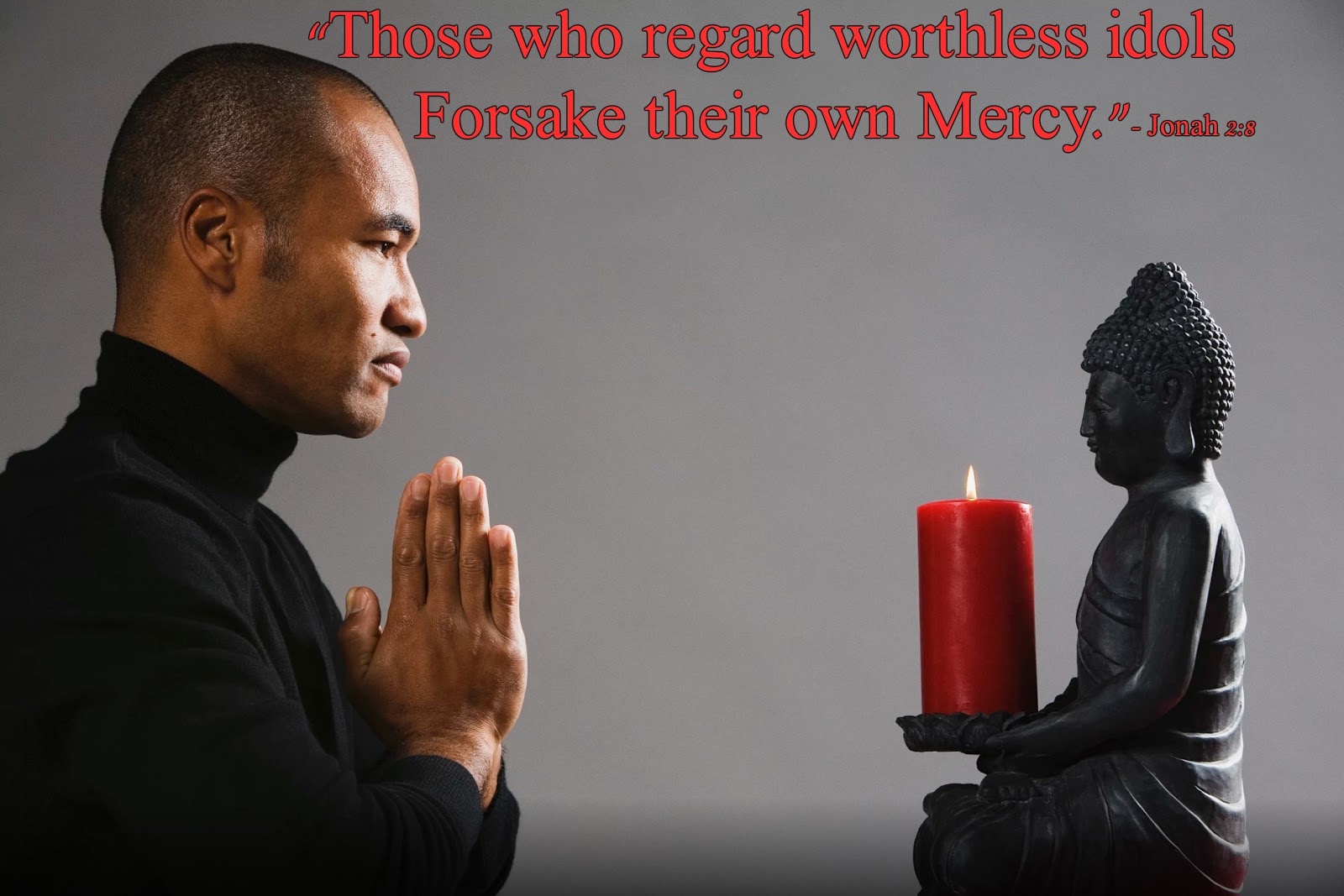
Here is a potential way to attract evil spirits: the worship of false gods. Tertullian (197 A.D.) said in his Apology addressed to the Rulers of the Roman Empire: “Let a person be brought before your tribunals; who is plainly under demonic possession. The wicked spirit, bidden to speak by a follower of Christ, will as readily make the truthful confession that he is a demon, as elsewhere he has falsely asserted that he is a god” (Apology, Ch. 23).
Another early Christian writer wrote: “Everyone who has at any time worshiped idols and has adored those call gods, or has eaten of the things sacrificed to them, is not without an unclean spirit; for he has become a guest of demons, and has been partaker with that demon of which he has formed the image in his mind, either through fear or love” (Pseudo-Clement, Recognitions 2.71).
As we will see, the spirits that heathens worship can leave them demonized (though they may not interpret it as such). The scriptures are clear that the one true God is unique and superior to all other conceptions of God and to the false gods people worship.
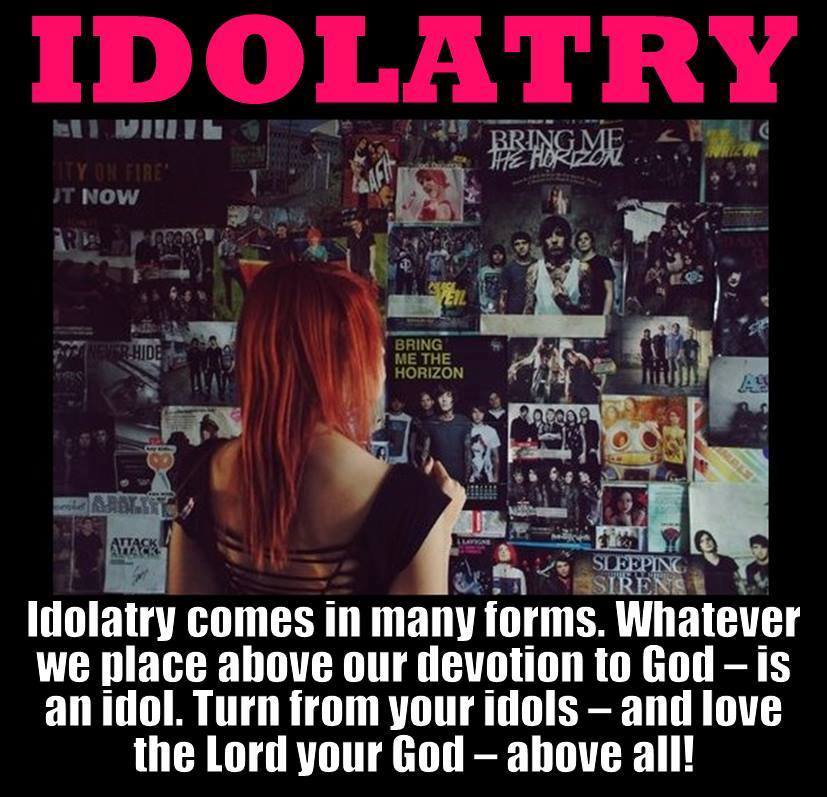
Idolatry has been prevalent throughout history, is so today, and will be at the time right before the Lord Jesus Christ returns (Revelation 9:20). What is idolatry? According to Webster’s Revised Unabridged Dictionary, it is “The worship of idols, images, or anything which is not God; the worship of false gods,” and the “Excessive attachment or veneration for anything; respect or love which borders on adoration.”
The cults and false religions universally promote idolatry, whether by the worship of a false concept of God or by the worship of an actual idol. Those who have studied the effect of idolatry on a people and their culture, whether in the ancient world or in places such as modern Asia, know the reason for the powerfully uncompromising biblical stand against it. Because when one worships false gods, all kinds of detestable things the LORD hates usually follow. It has been said that the transportation of an idol can actually bring serious physical disturbances, destruction, and death to the new locality. In some cases, nothing but the return of the idol to the former place would restore peace and tranquillity to the new locality.
The following is a remarkable case of demonization via idolatry encountered by missionary John L. Nevius in China during the years from 1854 to 1893:
The case of Mr. Kwo, who lived in Shantung Province, illustrates how a person came under demon domination through worshiping the goddess Wang Mu-niang, wife of the chief divinity of China. A demon appeared to him soon after and said: “I am Wang Mu-niang of Yuinmen san [the name of a nearby mountain]. I have taken up my abode in your house.” This announcement, made repeatedly by the demon, was the prelude to Mr. Kwo’s enslavement to the idol-spirit, who drove him to gambling in nearby towns, and then took possession of him as he was returning to his native village. He fell down unconscious, frothing at the mouth, and was carried to his house. The next day, in a violent attack, he attempted to shoot his father. With the help of neighbors, his father bound him with chains and took him to his home some distance away.
A doctor who was called in gave him large doses of medicine to no avail. He left and refused to have anything more to do with the case. For five or six days the victim raved wildly, and his friends were in great distress. In desperation, they proposed giving him more medicine. But the demon, speaking through him, replied, “Any amount of medicine will be of no use.” His mother then implored, “If medicine is of no use, what shall we do?” The demon replied, “Burn incense to me, and submit yourself to me, and all will be well.”
The parents of the victim knelt down and worshiped the demon, imploring him to torment their son no longer. During that time the victim was in a state of complete unconsciousness. A little later, when the demon drove the victim to renewed frenzy, his distraught parents repeated their promise to worship and serve him. They also promised that they would urge their son to do likewise. When the son regained consciousness, he reluctantly consented to do so.
The demon gave explicit directions regarding the proposed worship. On the first and fifteenth of each month, incense was to be burned, food offered, and the required prostrations made before the shrine of the goddess, Wang Mu-niang. Periodically the demon came, sometimes every few days, sometimes after a month’s lapse. Each time, the victim felt a fluttering of his heart, a sense of overwhelming fear, and inability to control himself. He would quietly ask his wife to fetch a neighbor woman whenever the demon came. The two would burn incense to the demon in the victim’s stead and receive his directives, which they then communicated to the possessed.
Although these communications were spoken by the victim’s lips, he was completely unaware of them, since he was in the demonized state. The demon often bade the audience not to be afraid, protesting he would not harm them, but rather help them in various ways. He declared he would instruct the victim in the healing art, so that people would flock to him to be cured of their sicknesses. This soon proved true, although many diseases were not under the demon’s control. Apparently only those afflicted by evil spirits were completely cursed. The victim’s long-ill child was not helped.
The demon declared he controlled many inferior spirits. He also frequently outlined his plan for his victim’s life and work. He promised he would help him grow more proficient as a healer, and the people would compensate him for his services. Gifts thus earned were to be donated to the nearby pagan temple.
In the summer of 1878, the demon-possessed man heard of the Christian gospel through one of Dr. Nevius’s native assistants. After trusting Christ, Mr. Kwo tore down the home shrine and ceased worshiping the demon. His sick child died a few days later. In great distress his wife urged him to restore the shrine and resume the worship, beliving her daughter’s death was caused by the offended demon. But the new Christian remained adamant and refused to break his bow to worship and trust in Jesus.
A few days later the demon returned and spoke through his victim to the wife” “I have returned but for one visit. If your husband is determined to be a Christian, this is no place for me. But I wish to tell you I had nothing to do with the death of your child.”
“What do you know of Jesus Christ?” she asked. The answer was: “Jesus Christ is the great Lord over all. And now I am going away, and you will not see me again.” “This,” testified the freed man, “was actually the last visit; we have not been troubled since.” Mr. Kwo faithfully witnessed for Christ in his village for many years, then emigrated to central Shantung in 1889. In his new home he continued to be a faithful witness for Christ, who had delivered him from the power of the demon.
Demons not only know Christ and his realm, they are experts in their own bailiwick. They share in the cunning subtlety and deception of Satan and carry on his work with great skill in an effort to blind the minds of unbelievers (2 Corinthians 4:4).
(Merrill Unger, Demons in the World Today, 144-147)
In the following video, a man prays to the spirits for a son. He allowed a “deity” to possess him in exchange for the acquisition of a son. He received a son, but the spirits threatened to take his son away when he decided to stop allowing them to possess him. It seems to not be uncommon for evil spirits to retaliate against a person if he is no longer doing their bidding. The spirits also attacked his health when he decided to become a medium for them. He even tried to free a person from a ghost’s persistent disturbance (which was really a demon masquerading) by calling upon his deities, but to no avail. Jesus Christ said, “…if Satan cast out Satan, he is divided against himself; how shall then his kingdom stand?” (Matt. 12:26). Only the Lord and God Jesus Christ have the power and authority over evil spirits, and He gives that authority to His believers (Luke 4:41; 10:19; 11:20).
Absolutely nothing good comes from satan’s kingdom. Satan and his angels only use people for their own ends, which are always evil.
The following is another example of the worship of false gods. The people seek to be possessed by their gods. But their gods will only destroy them in the end.
[The following video shows the piercing of skin and bloodletting of Taoist idolaters, which may not be suitable for some viewers]
Demons are behind all idols (Deut. 32:17; Psalms 106:36-38; 1 Cor. 10:19-20; Rev. 9:20). It would be wise to get rid of all idols if you have them in your possession.
The false gods throughout the world are just demons masquerading as gods – they are merely created beings. The ancient Egyptians worshipped their various gods, but they were no match for the omnipotent God of Abraham, Isaac, and Jacob.
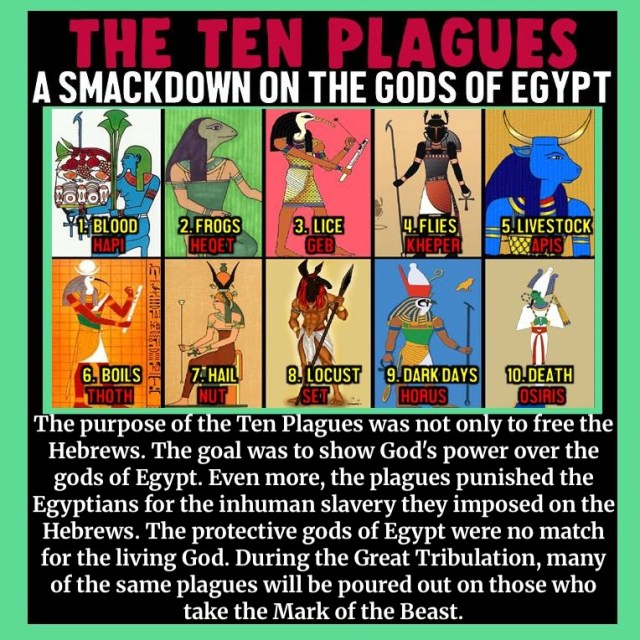
If you are a Christian, you should remember the events recorded in Exodus chapters 7-9 to confirm your faith in, and your fear of, this true and living God, the Judge of all the earth and the Almighty. He again embarrassed and defeated these evil powers through the Cross and His victorious resurrection. As Colossians 2:15 declares: “And having spoiled principalities and powers, he made a shew of them openly, triumphing over them in it.”
Scriptures Condemn Idolatry
“19 What say I then? that the idol is any thing, or that which is offered in sacrifice to idols is any thing?20 But I say, that the things which the Gentiles sacrifice, they sacrifice to devils, and not to God: and I would not that ye should have fellowship with devils” (1 Corinthians 10:19-20).
“5 For all the gods of the nations are idols: but the Lord made the heavens” (Psalms 96:5).
“For all the gods of the heathen are devils: but the Lord made the heavens” (Psalm 96:5 LXX).
“14 Therefore, my beloved, flee from idolatry” (1 Corinthians 10:14).
“4 Their sorrows shall be multiplied that hasten after another god: their drink offerings of blood will I not offer, nor take up their names into my lips” (Psalms 16:4).
“35 But were mingled among the heathen, and learned their works.36 And they served their idols: which were a snare unto them.37 Yea, they sacrificed their sons and their daughters unto devils,38 And shed innocent blood, even the blood of their sons and of their daughters, whom they sacrificed unto the idols of Canaan: and the land was polluted with blood” (Psalms 108:35-38).
“18 What profiteth the graven image that the maker thereof hath graven it; the molten image, and a teacher of lies, that the maker of his work trusteth therein, to make dumb idols?” (Habakkuk 2:18).
“25 Who changed the truth of God into a lie, and worshipped and served the creature more than the Creator, who is blessed for ever. Amen” (Romans 1:25)
“9 Know ye not that the unrighteous shall not inherit the kingdom of God? Be not deceived: neither fornicators, nor idolaters, nor adulterers, nor effeminate, nor abusers of themselves with mankind,10 Nor thieves, nor covetous, nor drunkards, nor revilers, nor extortioners, shall inherit the kingdom of God” (1 Corinthians 6:9-10).
“17 They shall be turned back, they shall be greatly ashamed, that trust in graven images, that say to the molten images, Ye are our gods” (Isaiah 42:17).
“And the rest of the men which were not killed by these plagues yet repented not of the works of their hands, that they should not worship devils, and idols of gold, and silver, and brass, and stone, and of wood: which neither can see, nor hear, nor walk:” (Revelation 9:20).
The following excerpt is from Compton’s Interactive Bible-NIV:
Idolatry (Gr. eidololatria). Idolatry in ancient times included two forms of departure from the true religion: the worship of false gods (whether by means of images or otherwise); and the worship of the Lord by means of images. All the nations surrounding ancient Israel were idolatrous…. The gods had no moral character whatsoever, and worship of them carried with it demoralizing practices, including child sacrifice, prostitution, and snake worship…. The word “idolatry” has no exact Hebrew equivalent. There are, however, a number of Hebrew words that are translated “idol.” They all give expression to the loathing, contempt, and dread excited in godly men by idolatry. The terms are as follows: (1) Aven, emptiness, nothingness”; (2) Emah, “an object of horror or terror,” referring either to the hideousness of the idols or the shameful character of their worship (Jeremiah 50:38). (3) El, the name of the supreme god of Canaan; used also as a neutral expression for any divinity (Isaiah 57:5). (4) Elil, “a thing of naught, a nonentity,” resembling aven in meaning (Leviticus 19:4; 26:1; 1 Chronicles 16:26). (5) Miphletseth, “a fright, a horror” (1 Kings 15:12; 2 Chronicles 15:16). (6) Semel, “a likeness, semblance” (33:7, 15). (7) Atsabh, “a cause of grief” (1Samuel 31:9; 1 Chronicles 10:9). (8) Etseb “a cause of grief” (Jeremiah 22:28 KJV). (9) Otseb “a cause of grief” (Isaiah 48:5). (10) Tsir, “a form,” and hence an idol (45:16). Besides the above words there are a number of others that are not translated “idol” but refer to it , expressing the degradation associated with idolatry: bosheth, “shameful thing,” applied to Baal and referring to the obscenity of his worship (Jeremiah 11:13; Hosea 9:10); gillulim, a term of contempt meaning “shapeless, dungy things” (Zephaniah 1:17); and shikkuts, “filth,” referring especially to the obscene rites associated with idolatry (Ezekiel 37:23; Nahum 3:6). Theologically, idolaters thought of their gods as spiritual beings (or forces) of cosmic significance and, theoretically, to them the idol was a focal point for worship. The [Old Testament] insists, however, that the heathen worship idols and nothing more (cf. Psalm 115:2-8; Isaiah 44:6-20).
(Encyclopedia of Cults and New Religions, 722)
Addendum
The following source reads:
To the Egyptians and Mesopotamians-and almost certainly to the Canaanites as well-images were not the inanimate objects that the Hebrew prophets insisted they were; rather, they were living, feeling beings in which the deity was actually present. The primary significance of images lay in the fact that the life of the deity was thought to be present in the statue. The Egyptian view is expressed in a passage from the Memphite Theology which says, “He placed the gods in their shrines, He settled their offerings, He established their shrines, He made their bodies according to their wishes. Thus the gods entered into their bodies, Of every wood, every stone, every clay” (AEL 1 :55 ). The gods were thought to manifest themselves in a variety of ways and to animate a variety of objects, but the cult image was a primary focus of the god’s presence on earth. Numerous Egyptian texts (though coming mostly from the Greek and Roman periods) describe the god in the form of a bird descending from heaven to alight on his image. Morenz (1973: 15 7) says that this figure “represents the living substance of the deity which is imparted to the inanimate image.” A similar view of images existed in Mesopotamia and appears to be an idea commonly associated with the use of images in religion (Bernhardt 1956). Oppenheim (1977: 184) says, “Fundamentally, the deity was considered present in its image …. The god moved with the image when it was carried off. … Only on the mythological level were the deities thought to reside in cosmic localities.” It is this living presence of the deity in the statue that accounts for the Mesopotamian practice of taking away the gods of a conquered people and depositing them in the temple of the victorious deity. This demonstrated the power of the conquering god and removed the deity from the conquered area so that he or she would not be able to help the people overthrow the conqueror’s authority. Certain literary compositions celebrate the return of the deity from exile to his or her city and the subsequent prosperity that the god’s presence brings.
This living presence of the god in the image was magically accomplished through the “opening (or washing) of the mouth” ceremony, a ceremony that Jacobsen (1987: 15-32) suggests was a cultic reenactment of the birth of the deity in heaven. The presence of the deity in the statue was then maintained through offerings and the proper care of the statue. Morenz (1973: 155) says that “from early times onward Egyptians were not satisfied with just fashioning an image, i.e., with the creation of a work of art. On the contrary, a ritual was performed on the statues while they were still in the sculptor’s workshop … , as a result of which the work of human hands was thought to come alive. This ceremony of ‘opening the mouth’ had the purpose of making all the organs serviceable and so vitalizing the image.” An Akkadian text (Ebeling 1931: 120- 21) dealing with the consecration of a sacred object (perhaps a statue, although the text is broken at the point where the object is mentioned) describes the purpose of the ceremony. It reads “this [statue ?] without the mouthopening ceremony cannot smell incense, cannot eat food, and cannot drink water.” Some texts suggest that the opening of the mouth ritual was performed on the statue periodically in order to maintain the vitality of the statue.
The daily care given to the statue reflects the belief that the statue was alive and thus needed the same attention and sustenance that any living individual would require. Two meals a day were provided for the images in the Uruk temple, and Oppenheim (1977: 188-89) has provided a composite picture of these meals. A table was brought in and placed before the image, and water for washing was provided. Various dishes including specific cuts of meat were presented to the statue and finally fruit was brought in an aesthetically attractive arrangement. Musicians played during the meal and curtains were drawn around the statue while the image partook of the food. The table was cleared and water was again provided for washing after the meal. Great attention was also given to proper and splendid attire for the image.
A similar situation prevailed in Egypt. Except for festive occasions when the image was carried in procession along the festival routes in a special shrine-where it was still normally hidden from the people-the cult statue was kept in a dark niche in the interior of the temple where it was accessible only to the officiating priest. Each day the priest opened the shrine containing the image, cleansed and perfumed it with incense, put a crown on it, and anointed and beautified it with cosmetics. According to Morenz (1973: 88) the purpose of this cultivation “was to furnish the image with vital force and to ensure that the deitywith whom it is not identical-lodges within it.”
Among the numerous figurines used for apotropaic purposes are some that can be identified as deities, and perhaps some of these were household gods similar to the teriipim of Gen 31:30. The protective function of many of the Mesopotamian figures is clear from inscriptions like “that the foot of evil may not approach a man’s house” or “overthrower of the evil gallil demons” found on some of them (see Rittig 1977: 185-208 for a collection of these inscriptions). They also probably served to promote good fortune and prosperity for those who possessed them.
(Edward M. Curtis, “Idol, Idolatry;” in The Anchor Yale Bible Dictionary, pp. 377-378)
If you don’t know Jesus Christ as your Lord and Savior, you can receive Him into your heart, and He can deliver you from darkness and sin and have your name written in His Book of Life.
If you are sincere, you can say this simple prayer to the Father (it doesn’t have to be word for word):
“God, I recognize that I have not lived my life for You up until now. I have been living for myself and that is wrong. Please forgive me of all of my sins just as I forgive others. I need You in my life; I want You in my life. I acknowledge the completed work of Your only begotten Son Jesus Christ in giving His life for me on the cross, I believe in my heart Jesus is Lord and was raised from the dead and I long to receive the forgiveness you have made freely available to me through this sacrifice. Come into my life now, Lord. Take up residence in my heart and be my king, my Lord, and my Savior. From this day forward, I will no longer be controlled by sin, or the desire to please myself, but I will follow You all the days of my life. Those days are in Your hands. I repent of my sins and turn to you. I ask this in the Lord and GOD Jesus’ precious and holy name. Amen.”
Discover more from Jesus Truth Deliverance
Subscribe to get the latest posts sent to your email.
 Jesus Truth Deliverance
Hi, is there any way I could share it on my Christian blog?
LikeLike
Yes, I think an easy way to do it is to just click on the Reblog icon near the bottom.
LikeLike
Reblogged this on Jesus Christ Delivers and commented:
Great article about idols, strong warning from another Christian. Praise Jesus for saving and delivering us from this evil.
LikeLike
Thank you, the reblog button did not show up before :-) Great information on your blog. God bless you and keep you.
LikeLike
You’re welcome. God bless.
LikeLiked by 1 person
That was very good & a ton of information. You did a lot of hard work thank you
LikeLiked by 1 person
Great reading yoour blog post
LikeLiked by 1 person