


Monism, or more accurately pantheistic monism, can be summed as “All is One, One is All, All is God. Monism is unscriptural since it denies the distinction between God and His creation. The living God is completely different from the creation, which he brought into existence by His creative powers (Gen. 1:1-3). The living God of the Bible God is “wholly other” and the only way he can be known is through Jesus Christ, the only-begotten Son of God (John ch. 1).
From the Encyclopedia of New Age Beliefs (X, XI):
Monism (monistic). Monism (from mono, “one”) is a way of seeing in which all reality, both the material and the spiritual, is conceived as a unified whole in which there are ultimately no real distinctions between things. That is, a blade of grass, a rock, a bug, a star, animals, and people are all one reality without ultimate distinctions. This extends to the realm of morals also, where there ultimately are no differences. In answer to a question such as “How many things are there?” monism responds, “Only one.”
In the New Age way of seeing there is a strong aversion to harsh dualism that are common in the West: natural/supernatural; temporal/eternal; material/spiritual; mind/body. Monism gives people a way out of these dualisms. It was the early Greek philosophers who influenced Western thought toward these metaphysical dualism, by setting body over against soul, matter over against spirit. Several hundred years later under the influence of neoplatonism and gnosticism, the human body and the material world were considered to be evil, while soul and spirit were considered to be good. Very harsh dualism were imposed on Western thinking from the time of the philosopher and scientist Descartes (1596-1650) and from later scientific thought. Descartes formulated an almost complete dualism between the physical world and the mind. Later scientific thought saw matter as total reality and excluded anything other-worldly from its equations.
Monistic theories differ considerably in the choice of the ultimate principle that “holds all things together,” sustains them, and unifies them. For example, in a materialistic monism, substance and energy of a physical nature are regarded as the only reality. Or in what we might call a spiritualistic monism the mind or spirit is taken as the only reality and explains the physical. The latter is prominent by far in the New Age way of seeing. In many schools of thought, this ultimate principle comprises opposites held in counterbalance, such as the complementary polarities yin and yang that make up the (spiritual) energy chi (from the Chinese mystical religion of Taoism).
The pop buzz-phrase for monism is “All is One, One is All.” The human problem, according to the New Age way of seeing, is that people just don’t see life that way. “salvation,” therefore, is equal to attaining an enlightened state of consciousness wherein a person discovers his or her “oneness”with all things.
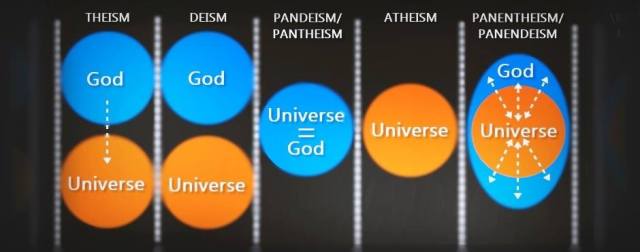
Pantheism, Panentheism. Pantheism (from pan, “all,” and theos, “god”) is a way of seeing that identifies everything with God and God with everything. Pantheistic views reach back to great antiquity, to Hinduism and to Brahmanism in particular; and although they are monistic in nature by definition, they vary in the New Age way of seeing according to what is meant by “God.” For example, the one great reality–everything– the temporal, the infinite, the seen, the unseen, the animate, the inanimate–may be designated as Nature, or the Cosmos, or the Self, and so on; that is, as “God.” Everything is a part of God, or God itself; and thus nothing, not a person nor any other thing, is separate or distinct from God.
Pantheism can be summed up by the pop buzz-phrase “God is All, All is God.” In Brahmanism, for example, the one great reality is Brahma(n), who dreams the world and the universe in which people find themselves. The dream is maya (illusion), and people find “salvation” by realizing that they are merely part of Brahman’s dream state and have been deceived by maya into thinking that the world is real.
Panentheism (en, “in”) puts a slight twist on this; it holds that the world and the universe are included in God but that God is more than these things. Whereas pantheism stresses immanence, panentheism, though it stresses immanence, maintains that the divine can be both transcendent and immanent. In a way, it is kind of a middle road between pantheism and monotheism. However, both are at great odds with a biblical Christian way f seeing because of their stress on the “divine within.” God is intimate rather than alien, indwelling rather than remote; people are not separated from God. The great contrast with the Christian faith, here, is that this kind of immanence encourages people to participate in divine life without the necessity of a mediator between them and God. In a biblical way of seeing, people are separated from God and access to God is through the cross of Jesus Christ.
Pantheistic monism. The term “pantheistic monism” is being used more and more frequently to describe what is perhaps the linchpin of the New Age way of seeing. It combines the ideas of pantheism and monism, and it can be summed up in the buzz-phrase “All is One, “one is All, All is God.”
If you don’t know Jesus Christ as your Lord and Savior, you can receive Him into your heart, and He can deliver you from darkness and sin and have your name written in His Book of Life.
If you are sincere, you can say this simple prayer to the Father (it doesn’t have to be word for word):
“God, I recognize that I have not lived my life for You up until now. I have been living for myself and that is wrong. Please forgive me of all of my sins, just as I forgive others. I need You in my life; I want You in my life. I acknowledge the completed work of Your only-begotten Son Jesus Christ in giving His life for me on the cross, I believe in my heart Jesus is Lord and was raised from the dead and I long to receive the forgiveness you have made freely available to me through this sacrifice. Come into my life now, Lord. Take up residence in my heart and be my king, my Lord, and my Savior. From this day forward, I will no longer be controlled by sin, or the desire to please myself, but I will follow You all the days of my life. Those days are in Your hands. I ask this in the Lord and GOD Jesus’ precious and holy name. Amen.”
Discover more from Jesus Truth Deliverance
Subscribe to get the latest posts sent to your email.
 Jesus Truth Deliverance
Well, well, someone’s insecure :3
“it’s a lie” isn’t an argument guys. Do better next time
LikeLike